

Khlobystov Y.V., Doctor of Economics, Prof., Academician of AES of Ukraine,
expert of the Crimean Tatar Resource Center
Climate change and its negative manifestations are becoming part of our lives. We see record temperature anomalies almost every month, long dry periods alternating with heavy downpours, heat waves in summer with unusually high temperatures and gale-force winds. An unexpected cool spring this year and a long winter in 2021. By the way, the meteorological winter began only in January. A long and cool spring has nothing to do with the general warming trend. We expect that in May we will observe mainly summer weather.
Crimea finally got a lot of precipitation and snow at the end of winter, but this did not solve the problem of providing freshwater resources. Why? The main answer is the destruction of landscape conditions for filling rivers and reservoirs through various infrastructure projects, chaotic development, uncontrolled drilling of wells in search of groundwater.
Today gives us reason to assert that we are witnessing manifestations of helplessness or unconscious transference to the future of the agreed and reasonable position of the Ukrainian side regarding the assessment of the damage caused by the so-called management of the Russian authorities in Crimea. How do we approach the assessment of the damage caused as a result of seven years of occupation?
The first part is harm to the natural environment, biodiversity, impact on protected areas, etc. Let's start with simple things. The territories of the nature reserve fund have repeatedly become the subject of a so-called creative approach to the existing borders and the borders that existed before 2014. The construction of the Tavryda highway was carried out without taking into account environmental legislation. The route passed through the Yalta Biosphere Reserve. But according to the first shock from this news, the next steps were the construction of civilian facilities on the territory of Foros Park (for more details – in the Ukrainian media and reports from Foros) with a violation of the ecosystem integrity of the facility, the Crimean Observatory, which is losing its scientific significance due to light pollution – the consequences of residential development in the village. Scientific, etc.
The second block of questions and claims is the state of the water resources of the peninsula and the attempt of the occupying authorities to resolve this issue due to the chaotic drilling of wells, small volumes of desalinated water, the senseless construction of hydraulic structures in the absence of surface runoff. The proposal to drill the bottom of the Sea of Azov or deep wells with a depth of more than 1000 m, in addition to skepticism, causes natural concern about the consequences of such activities for the environment.
The third block of questions is the state of soils in the central Crimea and environmental pollution in the north of the peninsula. Numerous accidents at Crimea Titan (now Titanium Investments LLC), the inability to support irrigated agriculture, the reduction in economic activity in the northwest and northeast of the peninsula – all this leads to a gradual and consistent neglect of environmental issues. It should be noted that so far we are not able to remotely assess the consequences of environmental pollution due to pollutant emissions at the Krasnoperekopsk and Armiansk plants, but even from the materials of the Russian media, the situation has long gone beyond the limits of a normal accident. Indirectly, it can be noted that the change in leaf color and its absence on trees in general indicates extremely dangerous levels of pollution after emissions at the Titan plant on August 23-24, 2018. Most likely, we are talking about exceeding the maximum permissible concentrations of pollutants in repeatedly. The consequences of emissions remote in time will be traced for years (by the way, as in the case of an accident (fire) at an oil depot in the Vasylkiv district, namely, in the village of Kriachki, Vasylkiv district, Kyiv region, which began on June 8, 2015 and lasted 8 days. The base belongs to LLC Bytremstroimaterialy and is part of the network BRSM-Oil. As of the beginning of the fire, there were 14 thousand tons of oil products. The amount of damage caused exceeded 1 billion hryvnias).
Now let's move on to valuation. How is the damage caused to environmental objects due to violation of environmental legislation now determined in Ukraine? There are appropriate methods approved by the government.
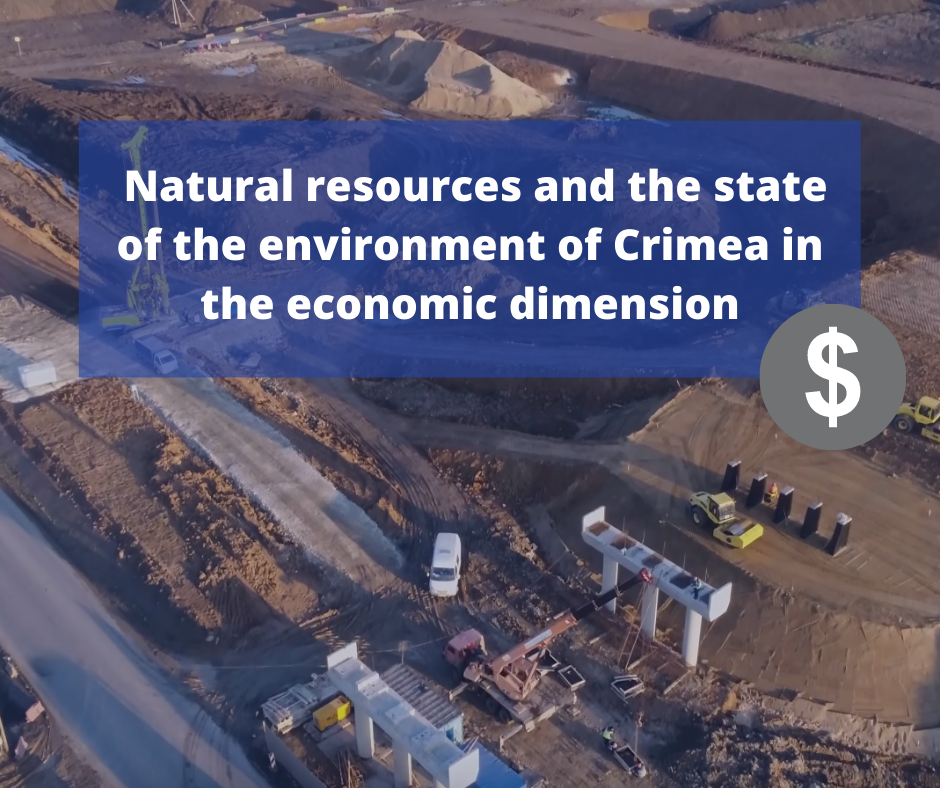
According to Russian sources, the motor road service of the Republic of Crimea compensated for the cost of trees and shrubs cut down during the construction of the Tavryda highway. Compensation for cutting down trees along the Tavryda was estimated at 249 million rubles. It is noted that during the construction and installation work along the new federal highway, more than 111 thousand trees and 116 thousand shrubs were subject to demolition. Due to the fact that, in the opinion of the occupation authorities, it is not advisable to carry out landscaping work along the Tavryda highway before the completion of work and carry out land reclamation, a monetary form of compensatory landscaping is provided in the amount of replacement cost. The amount of compensation amounted to more than 209 million rubles. The funds were transferred to the Ministry of Ecology and Natural Resources of the Republic of Crimea, which will decide on the volume and location of compensatory landings. And specifically, what should these funds go for? According to the so-called Deputy Minister of Ecology and Natural Resources of Crimea, Vladimir Kapitonov, about 10,000 trees are to be planted. I note instead of cut down 111,000 trees and 116,000 shrubs. So, just calculate that the price of planting 1 tree costs more than 20 thousand rubles. And another question: what kind of felled trees were they, how much conservation value did they have? There is not a word about this in the official reports of the Russian authorities and the media. According to Ukrainian law, illegal felling of one tree costs over UAH 10,000 to the culprit, and UAH 432 per bush. Thus, the damage caused only during the laying of the Tavryda highway to the forest resources and shrubs of Crimea is more than 1.15 billion hryvnias.
We follow, we observe, we accumulate information for a conversation in the international courts.