

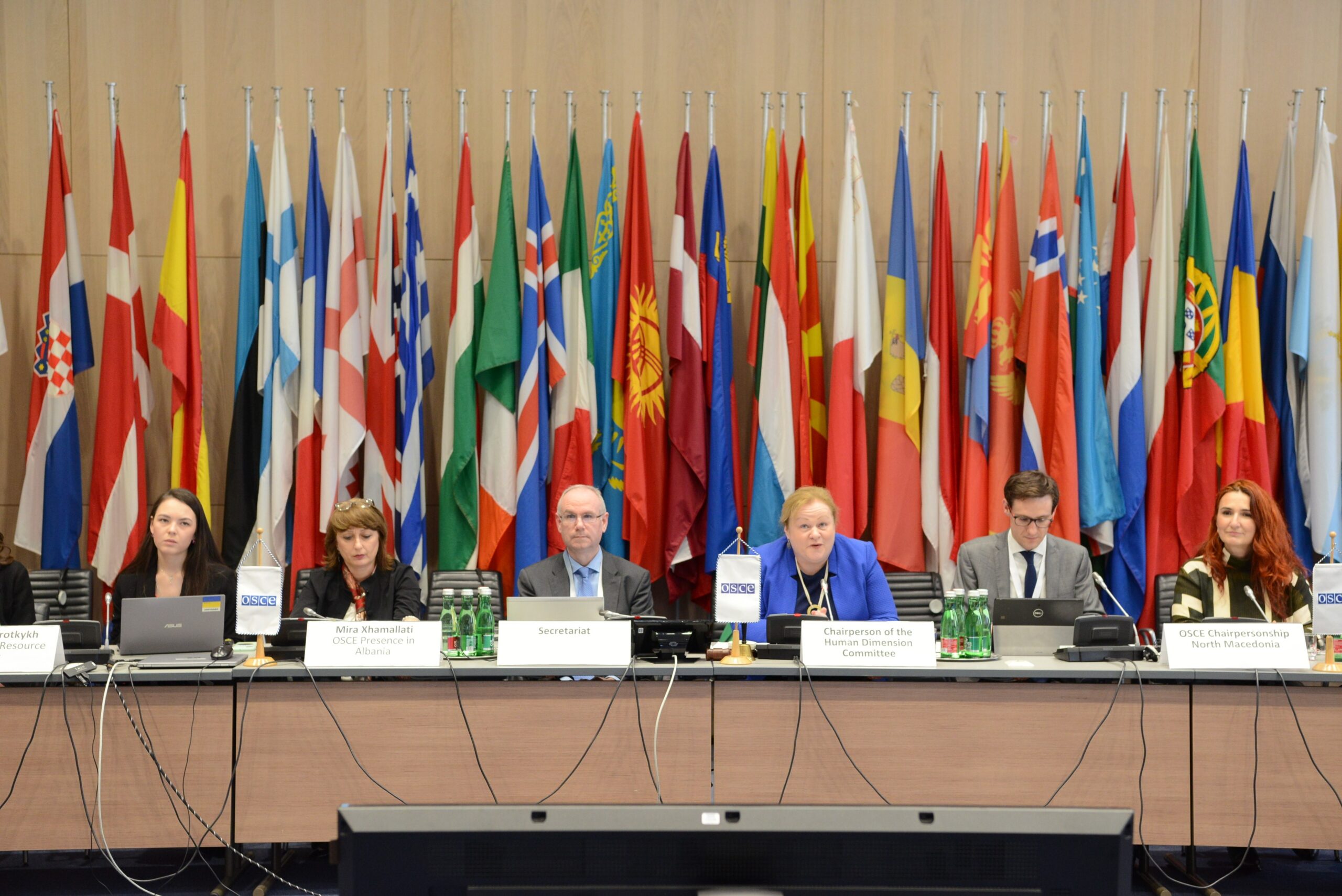
On Tuesday, May 16, a meeting of the Human Dimension Committee was held in Vienna (Austria).
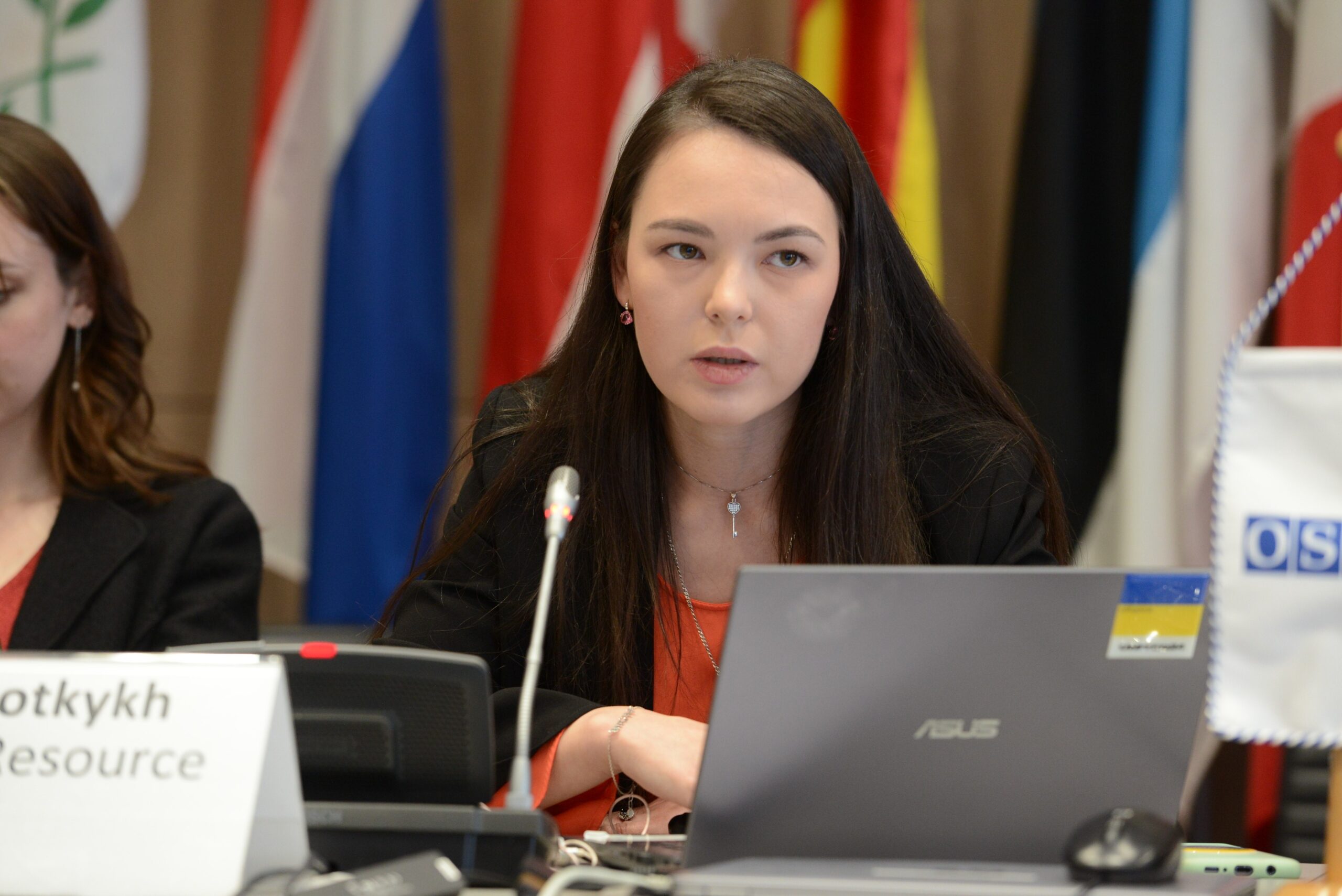
Liudmyla Korotkykh, Manager and Lawyer of the Crimean Tatar Resource Center, took part in this event. She spoke about the possibility of exercising the right to peaceful assembly in the occupied Crimea from 2014 to 2023, and in the newly occupied territories of Zaporizhzhia and Kherson regions in 2022 in the digital era.
Full speech:
The right to peaceful assembly and freedom of association are first-generation human rights, and it is extremely difficult to overestimate the significance and importance of this right.
The situation in Ukraine has proved that the opportunity and ability of society to implement its right to peaceful assembly is important not only in the context of participation in democratic processes, but also for the protection of its land, state, and sometimes life.
For example, the protest on February 26, 2014, near the building of the Verkhovna Rada of the ARC clearly and visually demonstrated the position of the residents of Crimea, including representatives of the indigenous Crimean Tatar people. Due to the fact that this protest was broadcast by TV channels and covered online, it neutralized any attempt by Russia to present the occupation of Crimea as a peaceful transfer of territory from one jurisdiction to another, including the so-called referendum. This was also proven in 2022, when, since the beginning of the Russian Federation’s full-scale invasion of Ukraine, residents of settlements threatened by the occupation came out to peacefully protest in support of territorial integrity. The ability to broadcast such protests in real time using modern technologies drew the attention of the entire international community to the fact that residents of Ukrainian cities do not want to live under Russian occupation. They are ready to resist it at the risk of their own lives. There have been numerous cases of violent dispersal of such gatherings by the occupiers. The Prosecutor’s Office of Ukraine has opened a number of proceedings on the facts of such dispersal, in particular in Kherson. The CTRC experts are working closely with law enforcement agencies in this area. They have prepared an expert legal opinion on the dispersal of a peaceful protest by military personnel with the use of weapons and violence as a gross violation of international humanitarian law. Among other things, this conclusion states: If a demonstration is a peaceful expression of political views, its dispersal, attacks on demonstrators, use of weapons against them, killing or maiming of demonstrators, constitutes a direct violation of Article 3 of the Fourth Geneva Convention. If such dispersal is aimed at intimidation and terror against the civilian population, it may be considered a violation of Article 51(2) of Protocol 1.
After gaining effective control over the Crimean Peninsula, the Russian authorities began unlawfully applying their own legislation. Although freedom of assembly is guaranteed by the Russian Constitution, the number of actual prohibitions on peaceful assemblies and unjustified interference in their organization and conduct has been increasing year by year. There have been several waves of legislative changes that have worsened the situation in this sphere. For example, the Federal Law No. 258-FZ, adopted in July 2014, introduced criminal liability for repeated violations of the rules for organizing public events. The occupation authorities also enacted laws that created additional obstacles to the exercise of the right to peaceful protests. The culmination was the inclusion of Article 20.3.3 (“Public Actions Aimed at Discrediting the Use of the Armed Forces of the Russian Federation”) in the Code of Administrative Offenses of the Russian Federation and Article 280.3 (“Public Actions Aimed at Discrediting the Use of the Armed Forces of the Russian Federation”) in the Criminal Code of the Russian Federation. Prosecutions under these articles sometimes took on an absurd character, where people were fined and forced to publicly apologize for listening to a Ukrainian song in a café or at a wedding.
May 18 is the Day of Remembrance for the Victims of Genocide of the Crimean Tatar People in 1944. Every year, mourning rallies and other events aimed at honoring the memory of the deportation victims used to be held on central squares in Simferopol and other populated areas of the peninsula. However, after the occupation of Crimea, the “authorities” only allowed one mourning rally to be held on the outskirts of the city in 2014, accompanied by numerous “law enforcement officers” and helicopters.
Currently, in Crimea, there is effectively a permit system for organizing public events, which means that obtaining permission to hold an event is required. According to Ukrainian legislation, a notification procedure is in place on the territory of Ukraine.
Requests for holding peaceful assemblies in Crimea are often rejected on formal grounds. In some cases, refusals to hold public events were issued based on unsubstantiated claims that “extremist” or “separatist” ideas would be disseminated at these events.
As a result, the ability to peacefully gather for public demonstrations in Crimea is practically impossible. The everyday practice includes refusals to coordinate peaceful assemblies, effectively banning them; threats against organizers and participants; and the prosecution of organizers and participants under criminal or administrative liability. A comprehensive list of places where Crimean residents can allegedly hold peaceful assemblies has been introduced. In practice, all attempts to express protest are suppressed by the occupation authorities.
In recent years, the only form of protest for the Crimean Tatar people has been their participation in so-called court hearings in political prisoner cases. Dozens, and sometimes hundreds, of people gather in front of “judges” buildings to support their fellow compatriots and express their disagreement with the ongoing repression. Typically, these individuals are detained and protocols are drawn up. While in previous years, fines were usually imposed, in 2022, the practice of administrative arrest for several days became more widespread. For example, on January 25, 2023, 34 activists of the Crimean Tatar people were detained when they came to participate in an open court hearing. Administrative arrests of 10 to 15 days were imposed on 27 of them, and one person was fined. The Crimean Tatar national movement has always pursued a non-violent struggle for the rights of their people. From 2015 to 2023, several individual pickets were organized, where tens to hundreds of people simultaneously held solitary pickets in different parts of Crimea to protest against the unlawful persecution of Crimean Tatars.
The use of modern technologies, on the one hand, enables a more effective and rapid exercise of the right to peaceful assembly. On the other hand, their unlawful and illegitimate use by the authorities creates new threats to civil society. For example, the capturing of photos and videos of any gathering of citizens, both in Crimea and in the newly occupied territories of the Kherson and Zaporizhzhia regions, leads to the use of such materials in fabricated criminal cases or becomes a basis for the abduction of individuals, as their active stance is seen as a threat to the occupying authorities.
Likewise, the organization of illegal surveillance when representatives of the Crimean Tatar people gather in mosques or other places for discussions on religious teachings becomes evidence of involvement in or support of a terrorist organization. Furthermore, the coercion of social media administrators to disclose personal data of users deprives residents of the occupied territories of the opportunity to exercise their right to peaceful assembly and freedom of expression, even online, as anonymity cannot be guaranteed in such cases.
The cases described above, where Crimean Tatars are prohibited from exercising their rights to freedom of association and peaceful assembly, are not isolated incidents. It is a systematic practice aimed at suppressing any civil activity of representatives of the indigenous people of Crimea, significantly limiting their opportunities for preservation and development, as they live in constant fear of persecution.