


On Tuesday, 30 July, the Crimean Tatar Resource Centre held a meeting with representatives of the US Department of State. The CTRC experts spoke about the situation with human rights violations in the occupied Crimea, provided recommendations for the next reports on the situation in the occupied Crimea, and the interlocutors discussed ways of further cooperation.
In particular, the meeting was attended by representatives of the US Department of State Deep Kaur, Michael A. Orona, Sydney Franklin, Natasha Gloger, Eskender Bariiev, Chairman of the Board of the CTRC, member of the Mejlis of the Crimean Tatar People, Zarema Bariieva, CTRC Manager, Liudmyla Korotkikh, CTRC lawyer, and Tetiana Savchuk, CTRC Communications Manager.
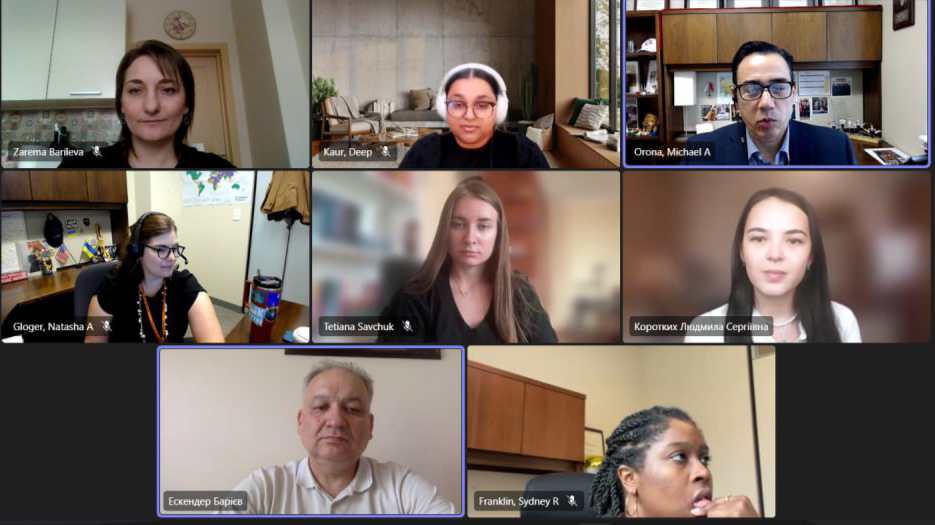
Representatives of the Crimean Tatar Resource Centre spoke about the situation with human rights violations in the occupied Crimea, about systemic repressions against pro-Ukrainian activists and representatives of the indigenous Crimean Tatar people. Eskender Bariiev, Chairman of the Board of the CTRC, outlined the main trends of human rights violations in the occupied Crimea and in the newly occupied territories of Zaporizhzhya and Kherson regions.
He noted that after the decision of the UN International Court of Justice, the occupiers increased pressure on the indigenous Crimean Tatar people.
‘In the first half of 2024, significantly more searches were recorded in Crimea compared to the same period last year. We attribute this to the fact that after the decision of the UN International Court of Justice, the occupants began to actively conduct searches and detentions, primarily of activists who are related to the Kurultai and Mejlis system. And, indeed, there were many such searches of members and chairmen of regional and local Mejlises,’ – he explained.
Crimean Tatars and Ukrainians in Crimea continue to be detained in cases related to Hizb ut-Tahrir, the battalion named after Noman Chelebidzhikhan, ‘high treason’, ‘espionage’, ‘discrediting the Russian Federation’ and etc.
In addition, it was noted about such a negative trend as the failure to report the crimes of the occupiers in Crimea.
‘Thus, the occupiers conduct searches at night, take away a person and say that if the relatives keep quiet, they will release the detainee. Of course, this cannot be believed. The situation with Ismail Shemshedinov is an example. At first relatives kept silent, and when parents and relatives began to search and practically visit all Russian occupation and law enforcement agencies, they began to answer that they had no arrests, no searches, no detentions. And it is still unknown where this man is,’ explained Eskender Bariiev.
The CTRC experts also spoke about the illegal mobilisation of residents of the occupied territories of Ukraine into the Russian army. It was emphasised that a large number of Crimean Tatars are now forced to leave Crimea in order not to participate in the Russian-Ukrainian war on the side of the Russian Federation.
The interlocutors agreed on further co-operation on documenting human rights violations in the occupied Crimea and in the newly occupied territories of Zaporizhzhya and Kherson regions.