

On Friday, June 11, in the village of Strilkove on Arabat Spit within the framework of the I International Investment Forum Southern Development Strategy, which lasted for June 10-11, a panel discussion was held on the topic: Temporary occupation of Crimea: risks for the south and ways to minimize them.
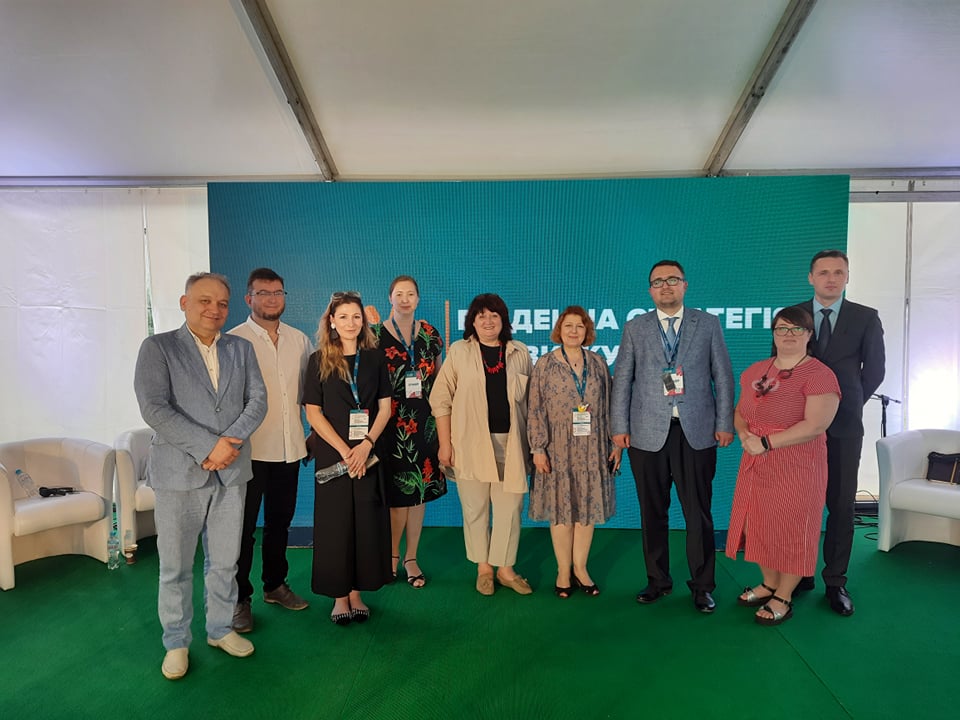
Discussion participants:
– Emine Dzheppar, First Deputy Minister of Foreign Affairs of Ukraine
– Anton Korynevych, Permanent Representative of the President of Ukraine in the Autonomous Republic of Crimea
– Eskender Bariiev, Head of the Board of the Crimean Tatar Resource Center, Head of the Department of Legal and Foreign Affairs of the Mejlis of the Crimean Tatar People
– Olha Skrypnyk, Chairman of the Crimean Human Rights Group
– Tetiana Kurmanova, Program director of Public Radio, author of a study on blocking problems in the south
– Valentyna Samar, Editor-in-chief, IA Center for Investigative Journalism
– Valentyna Potapova, Head of the educational direction of the Ukrainian Helsinki Human Rights Union, head of the Center for Civic Education Almenda
– Oleksii Tylnenko, Coordinator of NGO CrimeaSOS
– Yevhen Khlobystov, Expert of the Regional Center for Science and Technology, NaUKMA, Doctor of Economics, Professor.
During the discussion, the experts discussed the following issues:
– What is the Russian policy of information isolation of the occupied Crimea and its impact on the information security of southern Ukraine
– The ecological situation in the temporarily occupied Crimea and the cost measurement of the damage caused, the assessment of the cost of damage
– Maritime security of the south of Ukraine
– Educational and integration programs for young people from Crimea to enhance sustainable development of southern Ukraine
– Infrastructure and administrative services as a driver of development in the south of Ukraine
– The peculiarity of economic relations with the occupied Crimea
– The role of the Crimean Platform in achieving sustainable development in the south of Ukraine in the context of the implementation of the rights of indigenous peoples.
Head of the Board of the CTRC Eskender Bariiev, within the framework of his speech on the topic "The role of the Crimean platform in achieving sustainable development of southern Ukraine in the context of the implementation of the rights of indigenous peoples", informed those present about the current situation with the violation of human rights in the occupied Crimea and the long-term militarization of the peninsula.
"The occupation of Crimea and the waters of the Azov and Black Seas, their militarization is evidence of the growing threat from Russia not only in relation to Ukraine, but also to the countries of Europe and the Black Sea basin",- the expert noted.
In accordance with targets 16 of the Sustainable Development Goal, Bariiev made the following recommendations:
1. Stop the prevalence of all forms of violence against the Crimean Tatar people, Karaites and Krymchaks;
2. End the deprivation of adequate parental care for children through systemic arrests;
3. Ensure the implementation of the IV Geneva Convention on the territory of the occupied Crimea to ensure the rule of law and equal access to justice;
4. Stop illegal financial flows and militarization of the peninsula, step up activities to find and return abducted activists;
5. Provide people with legal (Ukrainian) identity cards, including birth certificates;
6. Ensure public access to information and protect fundamental freedoms in accordance with international agreements;
7. Strengthen international cooperation within the framework of the Crimean Platform for the De-occupation of Crimea, in order to build capacity at all levels in the prevention of violence and repression;
“It is symbolic that this forum takes place on the territory of the geographical Crimea. We are in the village of Chokrak, from where in May 1944 the Soviets forgot to deport hundreds of Crimean Tatars: old people, women and children, but in August 1944 they were put on barges and drowned in the Sea of Azov, alas, deportation is a long-term genocide, a crime against humanity, which has been going on since 2014”,- said the Head of the Board of the CTRC.
Bariiev thanked the President of Ukraine Volodymyr Zelenskyy for the initiative in submitting the draft law On the Indigenous Peoples of Ukraine. According to the expert, back in 2014 it was noted that this law is de-occupational and the reaction of the State Duma of the Russian Federation is confirmation of this.
Yevhen Khlobystov, during his speech on the topic: The environmental situation in the temporarily occupied Crimea and the cost measurement of the damage caused, the assessment of the cost of damage stressed that the environmental situation in Crimea requires constant comprehensive monitoring with the involvement of competent state bodies of the central and regional executive authorities, and scientists, experts, social activists.
“The existing and possible in the future facts of violation of the environmental legislation of Ukraine, the deterioration of the environmental safety of the territory of Crimea should be comprehensively assessed, in particular in terms of value, for further legal claims against the aggressor state in international courts”,- he stressed.
According to Khlobystov, one of the main recipients of violations of environmental legislation and irrational and sometimes predatory use of natural resources is the indigenous people of Crimea are the Crimean Tatars. They should be the object of special attention from the international community.