


Elina Khodakovska – actress of the theatre Between Three Columns told about the theatre performance ‘Crimean Tatar fairy tales. About Love’ by the representative of the Crimean Tatar Resource Centre. She also shared how her creative work began and how Crimean Tatars develop their culture in Ukraine. In addition, she said that the fairy tale ‘Kolobok’ is not so Russian.
Tell us more about your personal creative path in the theatre sphere. Where did it begin?
As a child, my brother suffered from hyperactivity, and that’s where my creative path began. So he was given to the only Ukrainian-language theatre studio that existed in Crimea at that time. I just went with my mum to the parents’ meeting of this studio. At some point the teacher Alla Vladimirovna Petrova said to my mum: ‘Bring your daughter, your son, it seems to me, will not be an actor, but your daughter can become an actress’. My mum replied that it was impossible, because at that time I didn’t communicate much with anyone and spoke only Crimean Tatar, I didn’t understand any other language. But the teacher insisted, so I was also brought to the studio. I remember that at the first three classes I sat under the chair, because I was very scared, but with time I got involved and started to learn. My teachers influenced me a lot, and if it wasn’t for them, maybe I wouldn’t be studying in Kyiv now. On their advice we enrolled in the only Ukrainian-language school.
My brother and I moved to Kyiv in 2014. Since we had been brewing in this environment, we understood what was happening, and after the so-called ‘referendum’ it became clear that we were already in Russia. The studio and its director, Alexander Polchenko, actively discussed these events, and this helped us to better understand the situation. I believe that it was thanks to the studio that we formed our self-identity as Ukrainians, because there was very little Ukrainian in Crimea.This little oasis had a big impact on me, my brother and our younger sister, helped us realise who we were and made us not put up with the regime.
Next were thoughts of other professions, maybe not acting, because everyone dreamed of journalism or other more stable professions. Besides, I was in a physics and maths class. But I was always drawn to acting. I tried to join a children’s theatre group, but I didn’t stay there because they said I wasn’t very talented. However, I kept in touch with teachers in Crimea, and they helped me to prepare for the entrance. My brother and I lied to my mum that I was going to be a TV announcer, but in the end I got a budget for acting. My mother understood and supported me. Then I went on to various theatres, studied at university, and now I work at the Theatre Between Three Columns.
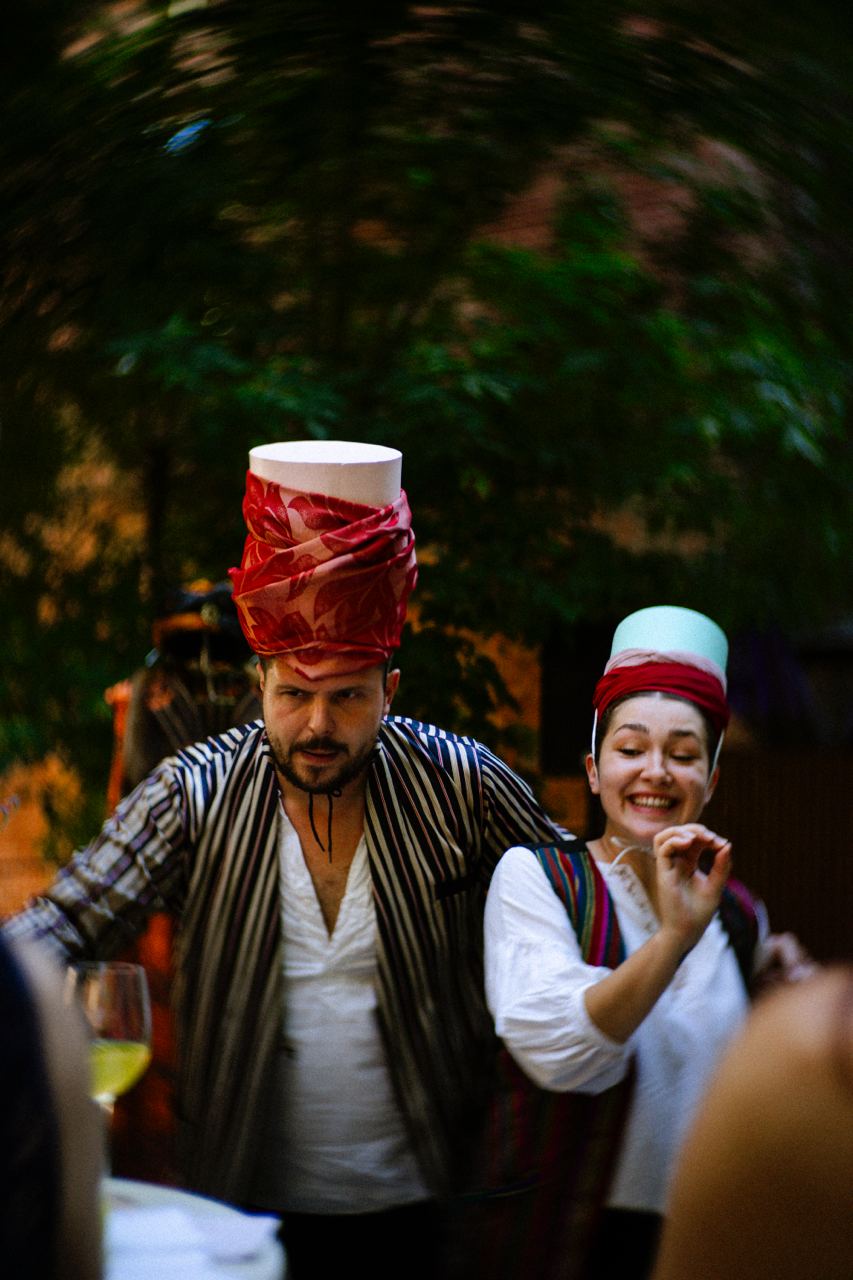
Where did the creation of the performance begin and what is the message embedded in the performance ‘Crimean Tatar Tales. About Love’?
Crimean Tatar fairy tales were created in the most difficult period of the theatre’s existence. At that time there was a very difficult atmosphere, it was cold in the room, and in general many circumstances interfered with the work. One evening there was a serious split, and Dmitry, the founder and director of this theatre, and I went home very sad and gloomy. And the next morning Dmitri said: ‘We should do Crimean Tatar fairy tales.’ Before that, two months before, I was given a photo session for my birthday by a Crimean Tatar, Arslan Ziadinov. We decided to make it ethnic, so we started looking for props for the photo session – pots, crockery and so on. In the process of preparing for the photo shoot, we were inspired by what was happening around us. A lot of people responded and provided us with props and costumes for free. It all resonated very vividly with us and maybe that’s when Dmitrн started to have an idea for fairy tales.
It was a big shock for me because after that split I woke up almost in tears. As an actress, not a founder of the theatre, I understood perfectly well how difficult it was for Dmitrн at that moment. But instead of putting his hands down, he said: ‘We’re making fairy tales.’ We sat down in the kitchen and started just reading fairy tales one after another. And then I came across the fairy tale ‘Kolobok.’ When we opened it, we realised that its content had been completely distorted by the Russians, although the name remained unchanged. If we translate ‘kolobok’ from Crimean Tatar, the word has a different meaning: ‘kol’ means hand and ‘bok’ means dung. That is, it is a round kolobok made with hands. The Russians twisted the meaning but kept the name, and when we realised this, Dmitry said: ‘This needs to be publicised.’ After all, this is not just bread that has been eaten, but a real story that has been twisted, as is often the case in imperialist Russia.
We started to choose fairy tales, and there were many wonderful ones among them, but we wanted the play to be a little bit about love, because the premiere was to take place on Valentine’s Day. We also chose those fairy tales that were technically easier to stage in our theatre. The main idea was not to create an accurate representation of the story or the costumes, but to draw out Eastern wisdom. We wanted to show that this wisdom is not somewhere far away in the East, not only in the fairy tales of Shaherezada or the works of Omar Khayyam, but also here, in Ukraine, among the Crimean Tatars.
In fact, the play itself begins with Dmitry talking about his journey to this idea. He talks about how Crimean Tatars describe their home with hyperbolic love: ‘There is no better sea than the Black Sea’, ‘There is no better mountain than Ai-Petri’. This, too, influenced our Eastern worldview. In the end, we collected six fairy tales and they went out into the world.
The audience responds very well to the performance, and I realise that we have achieved what we wanted. The most important thing was not the external spectacle, not the amount of scenery or music, but the oriental wisdom that is hidden in these fairy tales.
Can you tell us more about your acting role, which you play in this performance?
And all the fairy tales are performed by the two of us in this performance: just two actors – that’s me and Dmitry. They are constructed in such a way that there are no specific roles, only parts. So we can play many characters. For example, in the first fairy tale, Dmitry plays both the Padishah and the poor young man, and I play the three daughters. In the second fairy tale, Dmitry plays Kolobok, and I play the Fox, the Bear, and the Wolf. The form is built so that everything happens directly on stage with a minimum of scenery and costumes, which change very quickly. It’s a kind of ‘acting out’ – there are author insertions, but at the same time there is an inclusion of the characters.
So it’s hard to say that there is a specific role in each tale, because each tale has a set of parts. For example, we planned that in the fairy tale about the miser, Dmitry would play the miser and I would play the other roles. However, during the rehearsals we had something that didn’t add up, and three hours before the first performance Dmitry suggested we swap roles. So I started playing the miser, and he played other roles. Sometimes you have to make such drastic changes, but it’s for the overall success of the play.
We try to give the characters some special features. For example, in the first fairy tale we use toys in the form of animals that Dmitry makes himself. They are very ecological, made of fabric, and have oriental elements: all the characters have turbans on their heads, which gives them an oriental flavour. We didn’t try to reproduce historical costumes, but wanted the audience’s imagination to work and an oriental atmosphere to emerge.
For costume advice, we turned to my aunt Maire Luman, who is a costume designer. She gave us advice to avoid contradictions. For the second show, the famous Crimean Tatar artist Rustem was invited to the second show.
There are phrases in Crimean Tatar in the play, and in one fairy tale I don’t speak Ukrainian at all, only Crimean Tatar, and Dmitry translates. This allows Ukrainian viewers to get acquainted with this culture. For example, we explain the meaning of such words as ‘aga’ (addressing an older brother) and ‘khanum’ (addressing an honoured lady). Our goal is to familiarise Ukrainians with the richness of Crimean Tatar culture. For example, we explain the meaning of such words as ‘aga’ (address to the elder brother) and ‘khanum’ (address to the honoured lady). Our goal is to introduce Ukrainians to the richness of Crimean Tatar culture.
Why should people attend your performance? Main message.
‘Sometimes you don’t have to look far away to find something cool, cool, valuable – sometimes it’s right under your nose!’ – is the main message of our play.
We refer to Scheherazade, to Omar Khayam, to their wisdom: ‘No matter how many times you say the word “halva”, it doesn’t get sweeter in your mouth’. It is genius, it is childhood, school years, when we studied foreign literature with such oriental sayings. But in fact, the greatest wisdom we have in Crimea is oriental wisdom. It seems to me that Ukrainians lack this very much. I felt it especially after the outbreak of full-scale war, because before that many people sympathised with Crimea, but not deeper.
Now, when we get negative comments under videos like why Crimeans ‘gave up Crimea’, you realise that people really weren’t interested in this and succumbed to media propaganda. That’s why it’s important to highlight such moments. Fairy tales are something that reflects the soul of the people.
‘If you want to understand the soul of a people, read their fairy tales.’
This is something that is inculcated from childhood, those narratives that are spliced from childhood. That is why we turned to fairy tales, because they best describe the mentality. It is important to be interested not only in Crimean Tatar tales, but also in Karaite, Greek, and other peoples and minorities living in Ukraine. This is not only interesting, but also enriches us. When you understand among whom you live, you can draw knowledge from other people and become a three-dimensional person. Moreover, you can borrow something from other cultures that you like.
Dimitry, for example, has Jewish roots, and when we get to know each other’s cultures, we realise that they have a lot in common, although there are also differences that we want to borrow. But before borrowing something from another, one must first know one’s own well.
Even I, though I had been told fairy tales since childhood, did not know the tale of Kolobok, and it was as much of a shock to me as it was to others. If I did not know it, it is all the more important for the general public. We need to start with ourselves and then spread it further.
We need to pay more attention to dances, songs, fairy tales. We have a huge gap in this. What ‘Crimean Fig’ is doing is very good. They unite Crimean Tatar prose, Ukrainian poetry, and all this unites Crimea. It’s a great contribution. Jamala released an album called ‘Temple’, there are dances, performances, fairy tales. All this is important because sometimes just talking about Crimea is not enough. Sometimes you need something colourful to interest people.
We had spectators who after the performance went home, opened the Internet and started searching for Crimean Tatar fairy tales, expecting the same discoveries as with Kolobok. What could be the best result after the performance?
We believe that theatre is not only about emotions. When people say that they go to the theatre only for emotions, I resent it a little bit. Theatre raises many aspects and should do so. That is why it is important for us that we encourage people to take an interest in Crimean Tatar culture.
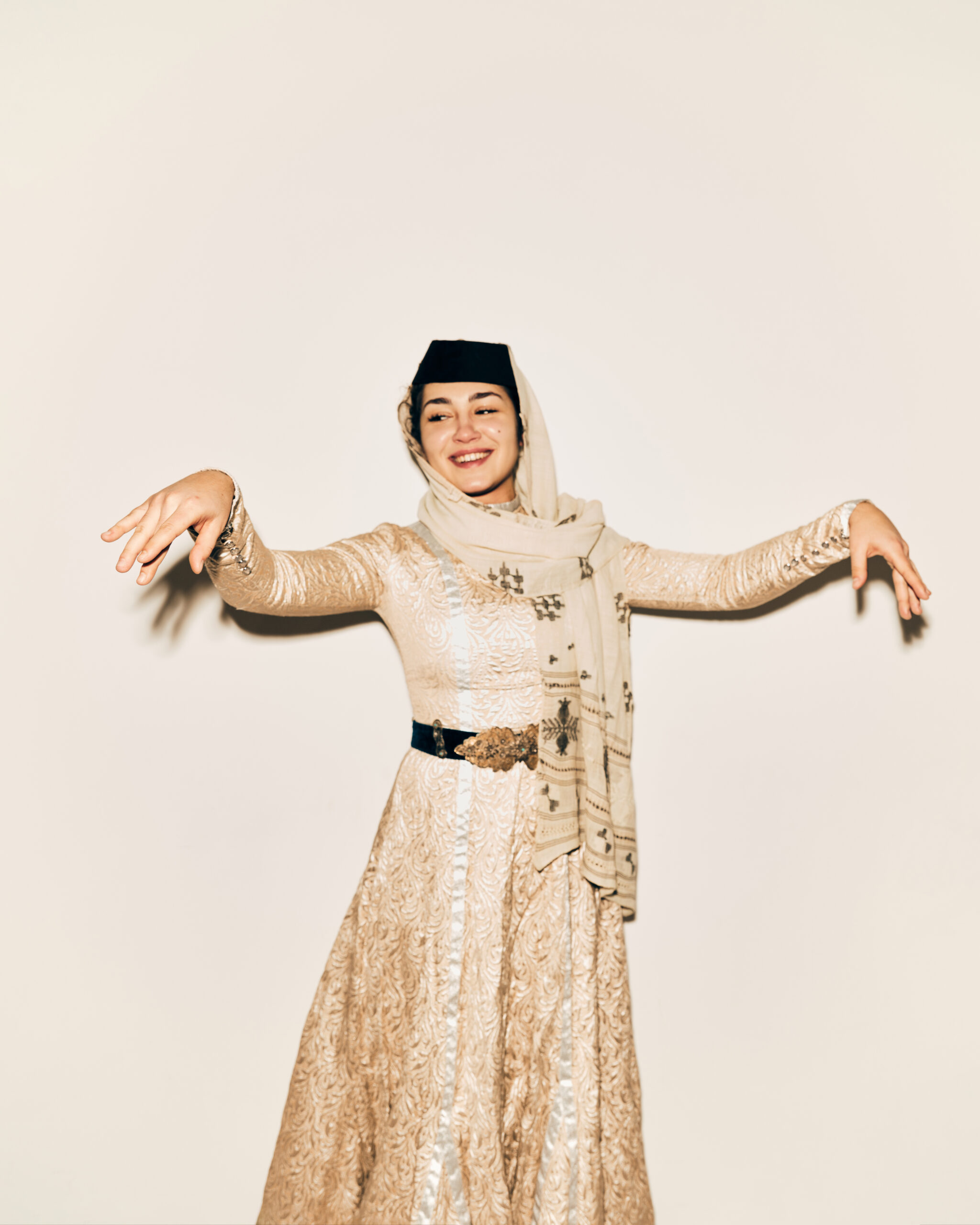
Do you plan to continue working on new plays related to Crimea and Crimean Tatars?
We do have an idea: firstly, to take other fairy tales and, for example, make them not about love, but about something else. At the moment there is no specific planned project about Crimea, but we want to produce a play for St Nicholas Day, especially for children, based on the Kurbas methodology. St Nicholas is not a fairy tale, but he is an important Ukrainian symbol that not everyone understands. Fairy tales for children, in my opinion, are always the best for performances, because on children it is very easy to check if a performance is successful: if a child keeps attention, it is very valuable.
In the nearest plans – not only this play, but also many other projects. One of them is ‘BMP’ – a big musical project of the theatre, where we adapt Ukrainian classical poems from the school curriculum, creating interesting music, mostly from three chords. We want to push Vysotsky out of Ukrainian works and let more Ukrainian sound.
Unfortunately, most pupils associate Taras Shevchenko only with boring verses, so we plan to develop different genre compositions to make it fun and energetic. Our goal is for children to sing Ukrainian, not Tsoi or other Muscovites.
As for Crimean Tatar fairy tales, we really want to realise them. We have already been on several tours and received a positive response, so we want more. The last performance we showed at several festivals, including Poltava, generated interest, and now we are actively looking for spaces where we can play, as well as interested people who would like us to come to them.
The nearest performances are for St Nicholas Day, and we are planning more fairy tales beyond that, because it is interesting for people. This is a great opportunity to get to know the culture of the Crimean Tatar people.
How do you want to see the future of Crimean Tatar culture in Ukraine?
Firstly, we need to do a lot of things, and on all fronts. I have already mentioned that we need to write new Crimean Tatar music, create works of Crimean Tatar drama, definitely plays. When I was still in my 5th year of university, my teacher told me to find a cool Crimean Tatar play and put it on. I realised that there are some and that they are cool, but there are very few. We need to compensate for a lot of things, because we have everything burnt down, only ashes left. We need to actively restore the cultural front of Crimean Tatar culture, and then, I hope, we will be able to restore at least part of what we have lost.
Now I realise that we had many achievements, but they were eradicated to the root, and to restore them is a very painstaking work. However, there are craftsmen who are doing it, and that is very valuable. Such projects should become bigger and bigger. Perhaps in our case we can translate quantity into quality. However, there is a tendency that we like to immediately make remarks – both Ukrainians and Crimean Tatars – and again say that ‘this is not so’. In this sense, sometimes we want to say, ‘Let there be an opportunity to choose. You can choose quality from quantity’. When a person starts, he always wants everything to be perfect, but for that you have to make attempts.
Got some interesting criticism, although I didn’t ask for it at all. We did a poem ‘Days Pass, Nights Pass’ – Shevchenko’s translation. I picked up a couple of chords on the guitar, and it turned out to be a Shevchenko poem translated by Kandym. I was told on Facebook that the music sounds a bit like Kazakh music. Thank you! I also recorded the song, but they wrote to me that I was pronouncing it wrong. How many per cent of people would want to try again after comments like that? The percentage goes down a lot.
I always pay attention to these points, and while pronunciation may be dialectal, we shouldn’t communicate only in our bubble of habits, even linguistic habits. In this sense, it needs to be different: many attempts, even if they are unsuccessful. Among these failed attempts, it is very interesting to find something exceptional. That’s what the Crimean figs, Jamala, Skibin, Maire Luman do – they drip-feed from all the stories, tell in the archive, pull out what was lost.
The first part must necessarily be about recovery. Without an understanding of what came before, there will be no after. We must engage in new narratives and new ideas. Crimean Tatar music should develop already now not only in the ethnic direction, although this is very important, but also to experiment. I know that modern music can leave ethnic motifs, but it should be developed. Let it become something that will be interesting for everyone. I think that now we need to concentrate on quantity: if you get quality at once, it’s good, but if you don’t, you still need to do more. The more you do, the more there will be.
Where would you advise people to start exploring Crimea?
You need to approach it from the side that interests a person. If a person is very fond of music, let him start with Crimean Tatar music. If he is interested in reading, let him start with Crimean Tatar fairy tales. If he does not want fairy tales, he can start with Anastasia Legkova’s book ‘There is land behind Perekop’ – it will definitely arouse his interest. If a person is interested in painting, let him consider Crimean Tatar art works. If he is interested in ethnic costume, it is worth starting with the study of traditional clothing.
Here you need to motivate the person not to be lazy and start to explore what is interesting to him. For example, if a person is a builder, he can look at the specifics of construction in Crimea. For everyone, there is a little seed that can awaken interest. It could be painting, sculpture, costumes or other aspects of culture.
It is important not to impose on a person what he is not interested in. For example, if he does not like the story of Ismail Gasprinsky, you should not start with that. You need to find something that attracts his attention. A little bit of information about his interests can create a desire to learn more. I was in this situation myself when I needed to gradually gather different aspects of Crimean Tatar culture. I saw how people responded and supported me. When I approached those who work in the information field about Crimea, they were happy when I asked them to tell me about their tales or culture. It is very gratifying to be approached for knowledge.
Maire Luman will soon be releasing a book on Crimean Tatar costume. This will reach a large audience, because stage costume interests many people. So you should start with what is interesting, and further interest will generate even more interest. So always start with what you are really interested in!