

On Friday, November 20, employees and experts of the Crimean Tatar Resource Center presented the results of monitoring the water resources of the occupied Crimea according to satellite communications. According to the study, the peninsula is experiencing a reduction in the area of the water surface for virtually all large bodies of water. The average reduction in the area of the water surface from 2015 to 2020 is 32%: reservoirs – 43%, lakes – 25%.
The speakers at the event were:
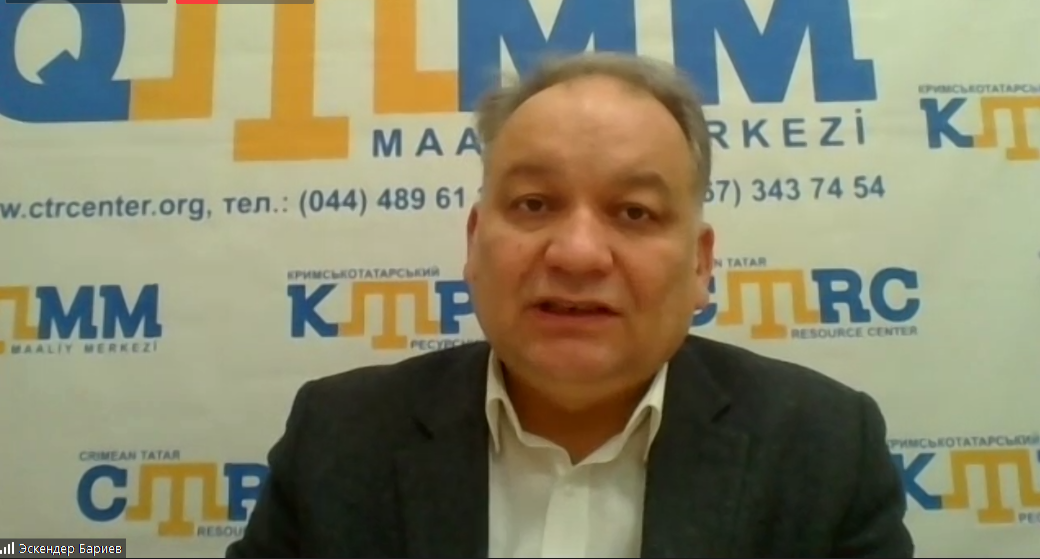
Eskender Bariiev – Head of the Board of the CTRC, member of the Mejlis of the Crimean Tatar people.
Members of the expert council on environmental protection and sustainable development of Crimea of the Crimean Tatar Resource Center:
Tetiana Kuchma – Leading Researcher at the Institute of Agroecology and Nature Management;
Ievhen Khlobystov – Professor of the Department of Ecology of the Kyiv-Mohyla Academy, Academician of the Academy of Economic Sciences of Ukraine.
Eskender Bariiev noted that since the beginning of the occupation of Crimea in 2014, the Russian Federation has not developed an effective strategy for providing water to the population of Crimea.
“Since 2014, the economic policy of the Russian Federation in Crimea has been based not on the available water resources of the peninsula, but on the expectation of water supply from the North Crimean Canal”,- stressed the Head of the Board of the CTRC.
According to him, during the period of the continuing temporary occupation of Crimea by the Russian Federation, the population of Crimea, including Sevastopol, was unlawfully increased from 2.5 million to at least 3.5 million. Moreover, as Bariiev noted, since 2014, Russia has built and commissioned numerous multi-storey housing stock in Crimea for those resettled from the Russian Federation, new production facilities have been launched, including two thermal power plants, as well as significant infrastructure facilities, primarily – roads, which required additional energy resources, including water supply.
“Moreover, since 2014, the occupiers have not carried out work to maintain the useful volume of the Crimean surface runoff reservoirs. Additional underground water sources, which were previously in an inviolable reserve, were discovered. The accumulation of groundwater was negatively impacted by the construction of the Tavryda highway since 2014, during which the rock layers were uncovered”,- said Eskender Bariiev.
Tetiana Kuchma said that the surveys were obtained on the basis of the Sentinel-1 radar satellite imagery, which allows receiving actual images every three days.
According to her, the average reduction in the area of the water surface from 2015 to 2020 is 32%: reservoirs – 43%, lakes – 25%.
According to the data obtained, since 2015, the water surface of the Taihan and Bilohirsk reservoirs has decreased by about 30%. The area of the Simferopol reservoir has also decreased significantly.

While monitoring the water resources of the peninsula, the average annual precipitation from 2010 to 2014 and from 2015 to 2019, the intensity of evaporation in the summer of 2020, the temperature of the earth's surface, the dynamics of the illumination index as an indirect demographic indicator were also taken into account.


According to the obtained data, the experts of the Crimean Tatar Resource Center came to the conclusion that:
1. Based on the results of the analysis of satellite images in 2020, a regional analysis of the intensity of drying of water bodies of the Crimean peninsula was made. There is a reduction in the area of the water mirror for virtually all large bodies of water on the Crimean peninsula, compared to the area of the water mirror in 2015. At the same time, the area of reduction of the water surface of reservoirs was higher, and amounted to 45% than the area of reduction of the water surface of lakes (25%). On the one hand, natural lakes may have an underground power source, but the difference in the reduction of the water mirror of natural water bodies and artificial hydraulic structures (reservoirs) can still indicate the impact of water management on the distribution of water supply.
2. Also, comparisons of drying intensity and climatic indicators such as rainfall, evaporation temperature during the summer of 2020, which are important for the distribution of water resources, show that the cause of water drying is not only the climatic factor. Thus, in some cases, in an area with higher relative rainfall and lower temperature and lower evaporation, a larger area of water mirror reduction was recorded, for example, in the case of the Simferopol Reservoir.
3. Analysis of the long-term dynamics of the water index within water bodies for the summer period in 2013-2020 shows a downward trend in the water index, which is also an indicator of water surface area, with a downward trend observed in 2015 or 2016.
4. For a more detailed study of the factors influencing water reserves, it is necessary to study the hydrological regime of individual water bodies with the involvement of terrestrial monitoring data and data on the level of surface water and groundwater intake.