

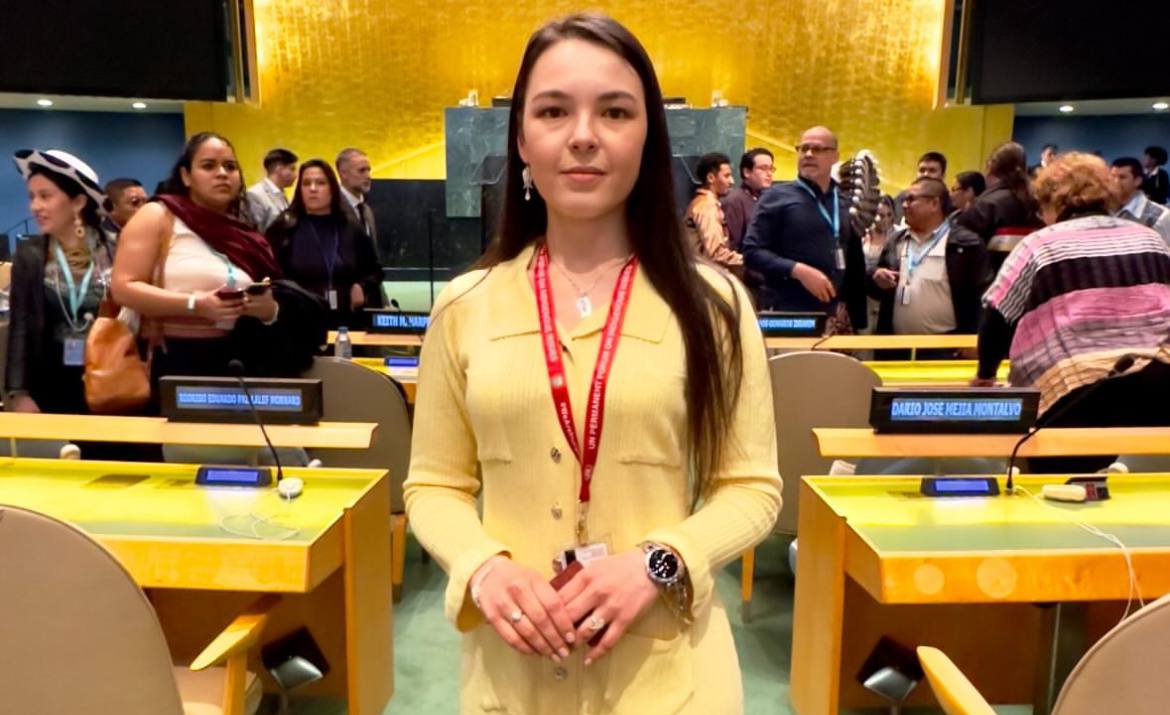
On April 22, in New York, the lawyer of the Crimean Tatar Resource Center Lyudmyla Korotkikh spoke at the 24th session of the UN Permanent Forum on Indigenous Issues as part of the discussion of agenda item 3: “Implementation of the UN Declaration on the Rights of Indigenous Peoples”.
“Indigenous peoples are not vulnerable groups in need of protection – we are rights holders. We have the right to self-determination, preservation and strengthening of our institutions and participation in decision-making,” emphasized Lyudmyla Korotkikh.
She noted that despite the formal recognition of the rights of indigenous peoples, their realization remains at a very low level. The situation of the Crimean Tatar people is especially critical, as their rights are systematically violated as a result of Russia’s occupation of Crimea, militarization of the peninsula and disregard for their cultural heritage. The full-scale invasion in 2022 only worsened the situation.
Korotkikh also emphasized that the violation of the principle of free, prior and informed consent is widespread around the world.
“The future of indigenous peoples should not be decided without the participation of indigenous peoples,” she said.
The lawyer recalled the adoption of the Law on Indigenous Peoples in Ukraine in 2021, but pointed out problems with its implementation – delays in the recognition of representative bodies and the adoption of bylaws.
In conclusion, Liudmyla Korotkikh called on UN member states to ensure the real participation of indigenous peoples in decision-making processes and to strengthen responsibility in protecting their rights.
Full text of the speech
Distinguished Chair, members of the Forum, colleagues,
My name is Liudmyla Korotkykh, and I represent the Indigenous People of Ukraine — the Crimean Tatars.
The UN Declaration on the Rights of Indigenous Peoples (UNDRIP) sets a clear standard: Indigenous Peoples are not vulnerable groups to be protected — we are rights-holders. We have the right to self-determination, to maintain and strengthen our institutions, and to participate in decision-making (Articles 3, 5, 18, 19).
Yet, the practice in many states shows that these rights are often recognized on paper but not realized in practice.
As the Indigenous Crimean Tatar People, we have faced more than a decade of occupation by the Russian Federation, during which our lands have been militarized, our cultural heritage endangered, and our rights completely ignored. Russia’s full-scale invasion of Ukraine in 2022 further worsened the situation.
At the same time, we must not forget the destructive impact of this war on Indigenous Peoples within the Russian Federation itself. Their rights are being violated, their lives lost, and their voices silenced.
Unfortunately, similar patterns are found in other regions, where Indigenous Peoples are excluded from decisions concerning extractive projects, infrastructure development, or military operations on their lands. These cases demonstrate a systemic problem: the failure to recognize Indigenous governance systems and to implement FPIC not as a formality, but as a legally binding obligation.
In Ukraine, the adoption of the 2021 Law on Indigenous Peoples was a historic step. However, the lack of implementation — including delays in providing legal statues to representative institution and adopting key by-laws — weakens this progress. The lesson is clear: symbolic recognition is not enough.
We acknowledge that positive practices do exist in some regions — where Indigenous Peoples have been granted space for self-governance and policy co-creation. These examples show that when Indigenous Peoples are included as equals, the outcomes are more just, democratic, and sustainable.
And I would like to emphasize the importance of the ongoing process to enhance the participation of Indigenous Peoples in the work of the United Nations, particularly in the Human Rights Council. I sincerely hope that the recommendations made by Indigenous representatives during the intersessional meetings will be taken into account and reflected in the upcoming resolution.
We call on:
- UN member states to ensure that national frameworks fully align with UNDRIP and guarantee the genuine, effective, and institutionalized participation of Indigenous Peoples in decision-making processes.
- The UN system to strengthen coordination and accountability for the rights of Indigenous Peoples across its agencies, and to ensure that Indigenous voices are heard not only in forums like this, but in all UN processes — from peacebuilding to climate action.
- All actors to reaffirm that Indigenous Peoples are not stakeholders — we are nations, peoples, and right-holders, and our free, prior, and informed consent must be the foundation of any decision that affects us.
The future of Indigenous Peoples must not be decided without Indigenous Peoples.
Thank you.