
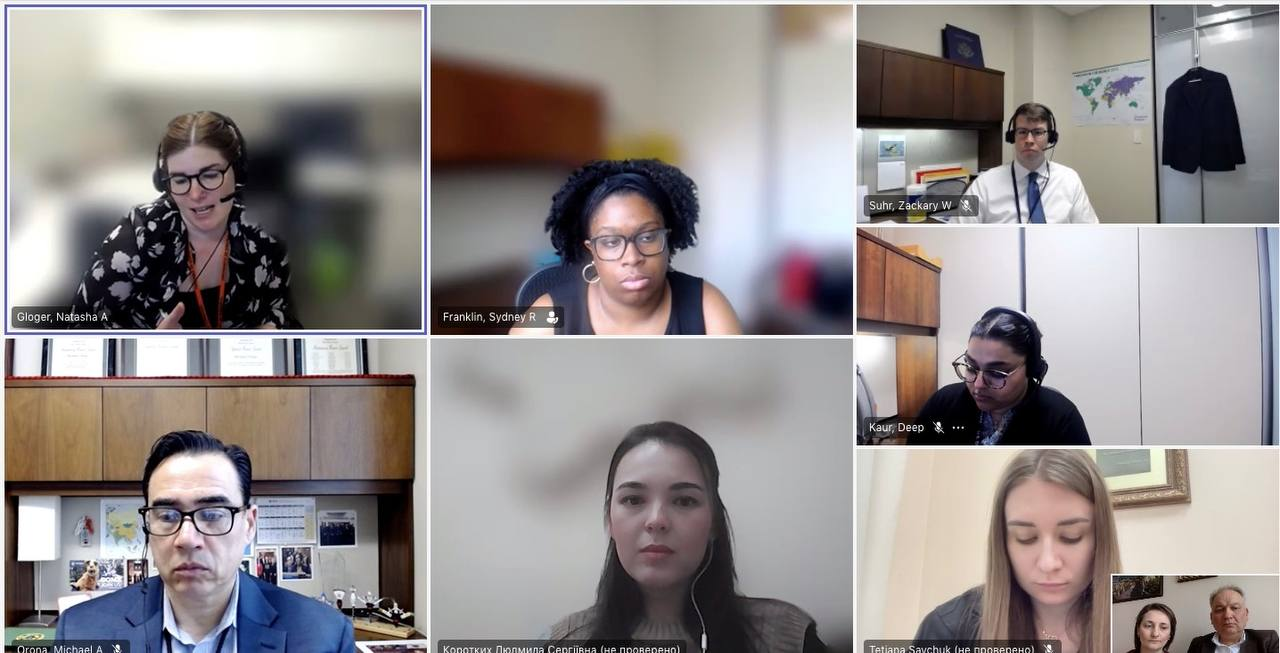
In particular, the meeting was attended by representatives of the Bureau for Democracy, Human Rights and Labor, the Bureau for European and Eurasian Affairs, as well as the Senior Advisor on International Indigenous Issues and Special Representative for Racial Equality and Justice, Eskender Bariiev, Head of the Board of the CTRC, Zarema Bariieva, CTRC Manager, Liudmyla Korotkykh, CTRC lawyer, and Tetiana Savchuk, CTRC Communications Manager.
Representatives of the Crimean Tatar Resource Center spoke about the situation with human rights violations in the occupied Crimea, about systemic repressions against pro-Ukrainian activists and representatives of the indigenous Crimean Tatar people. Eskender Bariiev, Chairman of the Board of the CTRC, outlined the main trends of human rights violations in the occupied Crimea and in the newly occupied territories of Zaporizhzhya and Kherson regions.
He noted that after the decision of the UN International Court of Justice, the occupants increased pressure on the indigenous Crimean Tatar people.
“Thus, the CTRC was recognized as an undesirable organization only after this decision. In addition, repressions against members of local and regional Mejlises in the occupied territories have intensified. Unfortunately, many such cases are silenced, which is a very negative trend,”- he explained.
Zarema Bariieva, the manager of the CTRC, drew attention to the fact that everyone is persecuted in the occupied territories without exception: men and women, young and old people, as well as seriously ill people. In addition, the lawyers of the Crimean political prisoners are subjected to repression on the peninsula, so they cannot continue to defend them.
The experts of the CRC told about the illegal mobilization of residents of the occupied territories of Ukraine to the Russian army. It was emphasized that a large number of Crimean Tatars are now forced to leave Crimea in order not to participate in the Russian-Ukrainian war on the side of the Russian Federation.
The representatives of the U.S. State Department were particularly interested in the information about the persecution of members of Mejlis of the Crimean Tatar people, religious persecution on the peninsula, the possibility of receiving education in the Crimean Tatar language, the preservation of the cultural heritage of the Crimean Tatar people in the conditions of the Russian-Ukrainian war.
In particular, the CTRC experts provided recommendations, among which it was suggested that against the background of violations of individual rights, a section on violations of collective rights of indigenous peoples should be included, the UN Humanitarian Response Plan on the Crimean Tatar people should be initiated, an Action Plan for the protection of the rights of indigenous peoples in the OSCE and CoE region should be developed, mechanisms for prompt response to cases of forced abductions should be developed, and international lawyers and advocates should be involved in the defense of political prisoners of the Kremlin.
“It is important that the next reports on human rights violations in the occupied Crimea and the newly occupied territories of Ukraine should not just include information on violations of individual human rights, but also highlight systemic repression and violations of the collective rights of Crimean Tatars as the indigenous people of Ukraine,” the CTRC experts noted.