

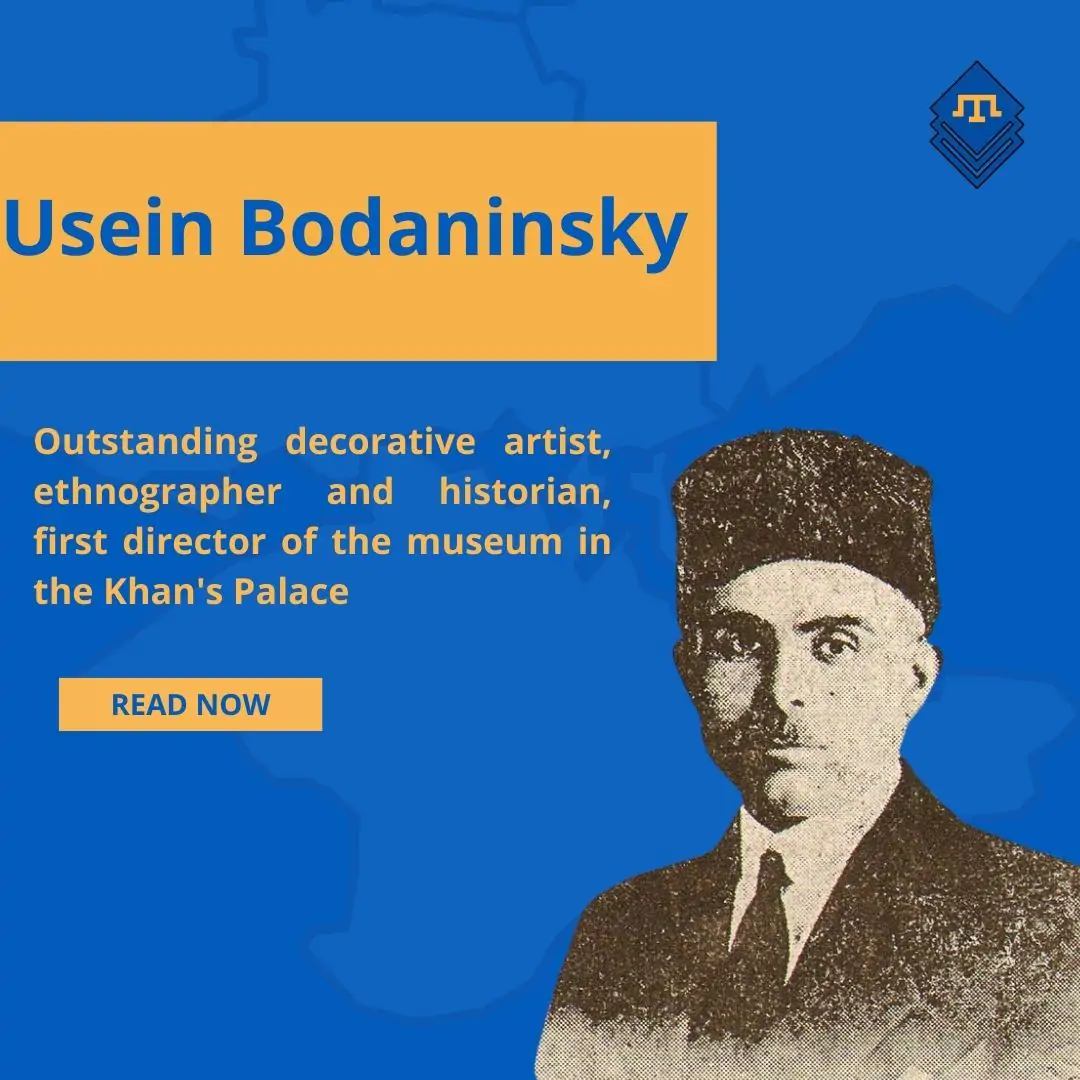
Friends, today we want to tell you about an outstanding representative of Crimean Tatar culture – Usein Bodaninsky, who was a decorative artist, ethnographer and historian, as well as the founder and first director of the museum in the Khan’s Palace.
He was born in 1877 in the village of Badana, Simferopol district, in the family of a teacher of the Crimean Tatar language and literature of the Simferopol National Tatar School. He first studied at the Tatar teachers’ school in Simferopol, and then studied art at the Moscow Stroganov School of Art and Industry and worked in various cities such as Paris, Istanbul, Dresden and St. Petersburg.
In general, Usein Bodaninsky lived outside of Crimea for twenty years, but when he returned, he immediately became actively involved in public life. He became a delegate of the Qurultay and settled in Bakhchysarai, where he deeply studied the history and ethnography of his people. Having founded the Bakhchysarai cell of the Petrograd Society for the Protection of Antiquities, in 1917 Bodaninsky became director of the museum in the Khan’s Palace.
It was thanks to Usein Bodaninsky that the Bakhchysarai Palace, which became famous already in the 18th century, has been preserved in its architectural beauty to this day. Also, thanks to Bodaninsky’s detailed and systematic approach, archaeological research was begun in Bakhchysarai and other regions of Crimea.
His scientific activities included numerous studies of the history and culture of the Crimean Tatars. The most famous is his 1925 expedition. It was then that scientists made a trip to 64 settlements in Crimea, recorded local folklore and described the life of Crimean Tatars in different regions of Crimea.
It is also important to note that Bodaninsky and his associates have a unique role in collecting authentic elements of the cultural heritage of the Crimean Tatars, many of which are stored today in museums in Ukraine. Some of these exhibits (products made of gold and silver, made using the filigree technique) are today presented as part of the Miras exhibition in Kyiv.
He was also able to include in the museum the cave cities in the Bakhchisarai region – Chufut-Kale, Manhup-Kale, Eski-Kermen and Tepe-Kermen, as well as all the Durbe mausoleums, ancient mosques and provide them with state protection.
In addition, Usein Bodaninsky was the initiator of the opening of the memorial house-museum of Ismail Gasprinsky.
Usein Bodaninsky headed the museum until 1934, but was later removed from his post. And already during the period of the Great Terror in 1937, he was arrested in Tbilisi on charges of participation in a counter-revolutionary nationalist organization and working for foreign intelligence and on April 17, 1938, along with other prominent figures of the Crimean Tatar cultural revival, was executed in Simferopol.
However, his efforts helped preserve a significant number of monuments of Crimean Tatar culture.