

On Thursday, July 22, the Crimean Tatar Resource Center presented an analysis of human rights violations in the occupied Crimea for the first half of 2021. The Russian Federation continues its repressions against our compatriots. Most of the violations by the occupants are attributed to the representatives of the indigenous Crimean Tatar people. This practice has become systemic on the peninsula.
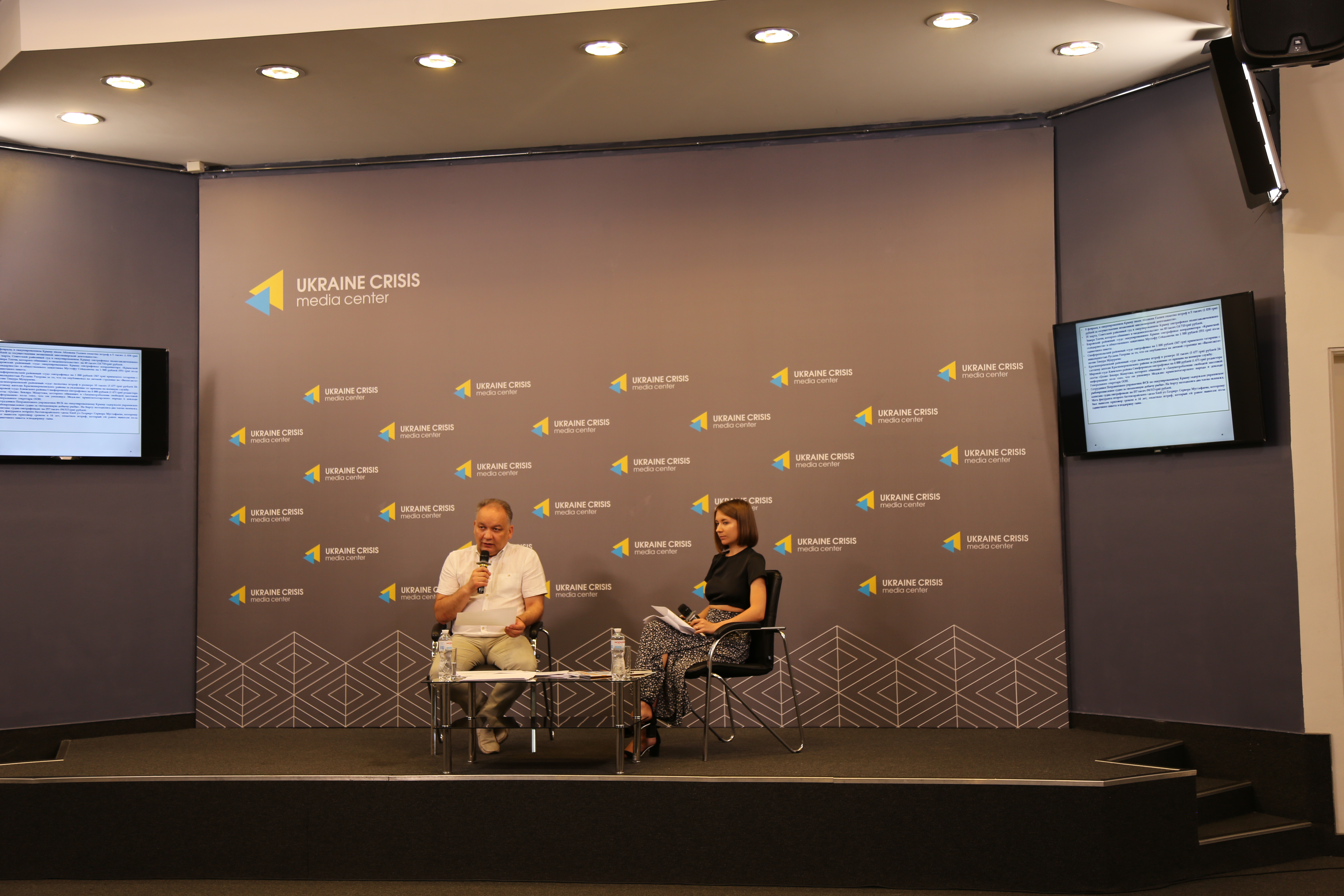
The press conference was attended by the Head of the Board of the Crimean Tatar Resource Center, Head of the Department of Legal and Foreign Affairs of Mejlis of the Crimean Tatar people Eskender Bariiev, communications manager of the Crimean Tatar Resource Center Tetiana Podvorniak, wife of political prisoner Vladyslav Yosypenko Kateryna Yosypenko.
According to the CTRC, in the first half of 2021, 33 searches were recorded in the occupied Crimea, 13 of which were carried out in the houses of the Crimean Tatars. This indicator exceeds the number of searches in the first half of 2020. Then the CTRC recorded 23 searches. The trend of persecution for political and religious reasons has remained unchanged since the beginning of the occupation of the peninsula.
In January, 3 searches were recorded: of the wife of the political prisoner Ivan Yatskin and of those suspected of justifying terrorism on social networks.
In February, security officials conducted 10 searches in the so-called Jehovah's Witnesses case, the so-called Hizb ut-Tahrir case and one in the house of activist Ludovica Papadopolu.
In March, 9 searches were recorded, which were related to the so-called case of Jehovah's Witnesses.
In April, 6 searches were carried out: 4 in the houses of the Crimean Tatars Abduselyam Selyametov, Seyran Taymazov, Eldar Fetlyaev, Ruslan Ramazanov without serious reasons, in the house of the brother of the defendant in the Hizb ut-Tahrir case Enver Seitosmanov, as well as in the house of a resident of Alushta for “appeals extremist activity ”.
In May, 4 searches were recorded: in the house of Aiub Rakhimov, in the house of the Hafarov family, where Aiub Rakhimov resided. And also in the houses of the Crimean Tatar activists: Zidan Adzhikeliamov and Muslim Zevriiev.
“During the searches, the security forces often violate the rights of the victims. In particular, during penetration into dwellings, cases of damage to property were recorded, or a search was carried out in the absence of the owner, or the planting of prohibited literature took place. In addition, during the search in May, Aiub Rakhimov was murdered. The occupants claim that he resisted the arrest”,- said Eskender Bariiev.
In the first half of 2021, 156 arrests / detentions were recorded in the occupied Crimea, 126 of which were in relation to the Crimean Tatars. The number has increased significantly compared to 2020, then 48 arrests were recorded.
“A number of recorded arrests were carried out after the searches. Residents of Crimea were detained on suspicion of involvement in the organizations banned in the Russian Federation: Hizb ut-Tahrir, Jehovah's Witnesses, for evading conscription into the Russian armed forces, for justifying terrorism in social networks, promoting terrorism, for high treason, it is known about the detention at the administrative border. Such a large number of violations in this category is also due to the fact that the occupants en masse detained activists who were driving from Crimea to the city of Rostov-on-Don to the announcement the verdict to the defendants in the so-called Bilohirsk Hizb ut-Tahrir case. Then it was known about 126 detentions, all in relation to the Crimean Tatars”,- said the Head of the Board of the CTRC.
It is worth to note the arrest of a native of Kryvyy Rih Vladyslav Yosypenko, who was detained after the rally dedicated to the birthday of Taras Shevchenko in Simferopol. Torture was used against him: it is known that Vladyslav was tortured with electricity for two days.
In the first half of 2021, 41 cases of interrogations, interviews and conversations were recorded in the occupied Crimea, 18 of which were in relation to the Crimean Tatars. Compared to last year, the number of such violations has decreased over the same period. Then 52 violations were recorded.
Crimeans detained after the searches were interrogated and questioned – on suspicion of involvement in the organizations banned in the Russian Federation: Hizb ut-Tahrir, Jehovah's Witnesses, on suspicion of allegedly justifying terrorism in social networks, promoting terrorism, high treason. One interrogation was conducted by Russian security officials at the administrative border with the occupied Crimea. In addition, during the reporting period, there were numerous cases of interrogations of relatives of political prisoners, activists who carried out solitary pickets.
In the first half of 2021, 96 cases of arrests were recorded in the occupied Crimea, 60 of which were against representatives of the indigenous people. Out of 96 cases: 27 – sentences, 14 – new arrests, 55 – extensions of detention. During the first half of last year, 150 cases of arrests were recorded. The number of arrests, according to CTRC experts, has decreased due to the coronavirus pandemic.
During this period, the occupation courts sentenced:
defendants in the so-called Bilohirsk Hizb ut-Tahrir case Enver Omerov to 18 years, Ayder Dzhepparov to 17 years, Riza Omerov to 13 years in prison.
pro-Ukrainian activist Oleh Prykhodko to 5 years in a maximum security colony with the first year in prison.
political prisoner Medzhyt Abliamitov, suspected of allegedly participating in the Noman Çelebicihan Crimean Tatar Volunteer Battalion, to 6 years in a strict regime colony with a 1 year probation.
Halyna Dovhopola to 12 years of imprisonment in a general regime colony, with a probation for 1 year.
Viktor Stashevskyy, suspected of participating in the Jehovah's Witnesses religious organization banned in Russia, to six and a half years in prison.
the owner of the Crimean Tatar TV channel ATR Lenur Islyamov to 18 years of imprisonment in a strict regime colony, as well as 1 year of probation (the sentence was changed).
Ukrainian serviceman Yevhen Dobrynskyy to 3 years 6 months in prison for illegal border crossing and drug smuggling.
political prisoner Ivan Yatskin to 11 years in a strict regime colony with a 1 year probation.
a citizen of Ukraine for a period of 1 year, with serving a sentence in a general regime correctional colony for creating an extremist community.
Chairman of the Mejlis of the Crimean Tatar people Refat Chubarov to 6 years in prison in a general regime colony, a fine of 200 thousand rubles and 200 hours of correctional labor.
former political prisoner Edem Bekirov to 7 years in prison in a general regime colony and imposed a fine of 150,000 rubles.
two men to 8 years in prison for participating in the Noman Çelebicihan Crimean Tatar Volunteer Battalion.
In the period from 22 to 31 January, the occupants arrested 12 people for participating in a rally in support of Navalny: Viacheslav Neievin, Oleksandr Krytskyy, Oleksandr Baklytskyy, Illia Zaik, Artem Lukashov, Serhii Lukashov, Anastasiia Lukashenko, Maksym Bychkov, Andrii Kravtsov, Maksym Rozum, Danylo Kovalenko, Tetiana Stepina.
The following were illegally taken into custody by the decisions of the occupation courts:
activist Nina (Latifa) Malakhova, who was put under house arrest.
Crimean Tatars detained after searches – Ernest Ibrahimov, Tymur Yalkabov, Azamat Eiupov, Oleh Fedorov, Lenur Seidametov and Yashar Shykhametov.
Vladyslav Yosypenko, who was sentenced to arrest.
42-year-old Taras Kuzio, who is suspected of financing an extremist organization – Jehovah's Witnesses. He was put under house arrest.
Crimean opposition activist Illia Bolshedvorov. He was arrested for 10 days due to the fact that he was filming a solitary picket, which took place on January 22.
two citizens of the Russian Federation on suspicion of aiding terrorism. They were arrested for two months.
a resident of Alushta in the occupied Crimea, a citizen of the Russian Federation for calls for extremist activities.
a citizen of the Russian Federation on charges of alleged treason. The FSB claims that the man purposefully collected and transmitted information about the activities of the Black Sea Fleet to the Main Intelligence Directorate of the Ministry of Defense of Ukraine.
In the first half of 2021, 205 cases of violation of the right to a fair trial were recorded, 130 of which were against representatives of the indigenous Crimean Tatar people. This figure is lower than last year, but the very number of violations of the right to a fair trial demonstrates the illegal activity of the so-called courts in the occupied Crimea, by decisions of which more than 100 political prisoners of Crimea continue to be held in pre-trial detention centers and prisons.
At least 14 people were illegally taken into custody, at least 27 verdicts were passed in the so-called cases. In addition, the CTRC recorded 55 cases of prolongation of detention terms. It is also worth noting that in the first half of 2021, the so-called courts continued to reject appeals and defense motions in the so-called cases of political prisoners of Crimea.
“According to the CTRC experts, the indicators of violation of the right to a fair trial testify to the continuing discrimination against ethnic groups, indigenous peoples and pro-Ukrainian activists. The Russian Federation illegally uses its legislation for political purposes, in particular, with the aim of suppressing the non-violent struggle of the Crimean Tatars and their protest against the occupation of Crimea”,- said the communications manager.
Violations of the right to healthcare access are also systemic, and in the first half of 2021, 92 cases of violation of the right to healthcare access were recorded, 62 of which were in relation to the Crimean Tatars. This indicator exceeds the number of such violations in the first half of 2020. Then the CTRC recorded 74 cases, of which 58 were in relation to representatives of the indigenous people. We see that the number of violations has increased in relation to the Crimean Tatars.
As communications manager Tetiana Podvorniak noted that this trend characterizes a deliberate policy of not providing adequate medical assistance to political prisoners in Crimea in places of detention, especially against the backdrop of the coronavirus pandemic.
It is worth noting the defendant in the so-called second Simferopol Hizb ut-Tahrir case, Servet Gaziev, who was called an ambulance at least 5 times. Doctors gave only painkillers. The same situation is observed with another defendant in the so-called case, Dzhemil Gafarov, who has exacerbated chronic kidney disease and gout. But the administration of the pre-trial detention center does not provide proper medical assistance.
A number of political prisoners were subjected to a compulsory psychiatric examination, many were placed in punishment cells and special blocks.
An illustrative case is the journalist Vladyslav Yosypenko, who was tortured by the security forces of the occupied Crimea.
According to the organization, in the first half of 2021, 36 cases of transferring of the political prisoners of Crimea were recorded, 35 of which were against representatives of the indigenous people.
The CTRC report also contains information on the violation of religious rights, environmental norms on the peninsula, on inappropriate conditions in pre-trial detention centers and prisons, on the violation of the rights of political prisoners, on the violation of women's rights and illegal military exercises in the occupied Crimea.