

On Tuesday, November 24, the Crimean Tatar Resource Center and the Mejlis of the Crimean Tatar people presented an online analysis of human rights violations in the occupied Crimea for 9 months of 2020. According to the monitoring data, during the reporting period, 40 searches were recorded on the peninsula, 68 cases of arrests, 70 – interrogations, interviews and conversations, 195 arrests: 48 new arrests and sentences, 147 extentions of detention for political prisoners of Crimea. In addition, it is known about 332 cases of violations of the right to a fair trial, 112 to the highest attainable standard of physical and mental health, and 33 cases of transferring political prisoners from Crimea.
The speakers at the event were:
Eskender Bariiev – Head of the Board of the Crimean Tatar Resource Center, member of the Mejlis of the Crimean Tatar people;
Refat Chubarov – Chairman of Mejlis of the Crimean Tatar people;
Tetiana Podvorniak – communications manager of the Crimean Tatar Resource Center.
The conference participants revealed the main trends, dynamics and the number of offenses on the peninsula for 9 months of 2020.
So, according to Eskender Bariiev, for 9 months of 2020, at least 40 searches were recorded in the occupied Crimea, 25 of which were carried out in the houses of the Crimean Tatars. This indicator is 2 times less than last year for the same period. This trend is associated with the coronavirus pandemic.
“Despite the decrease in the number of searches in the reporting period, the tendency to conduct mass searches on suspicion of involvement in the organization Hizb ut-Tahrir and Jehovah's Witnesses banned in the Russian Federation remains unchanged. Also, formal reasons for conducting searches were allegedly participation in the Noman Çelebicihan Crimean Tatar Volunteer Battalion, espionage in favor of Ukraine, extremism, incitement to hatred or enmity, etc.”,- emphasized the Head of the Board of the CTRC.
During the reporting period, 68 arrests were recorded, 28 of which were against Crimean Tatars. As Eskender Bariiev noted, the dynamics of the number of detentions were compared to 2018 and 2019. Over the same period, it also shows a decline: in 2019, over 9 months, 126 cases of detention were recorded, in 2018 – 91.
“As a rule, arrests are carried out after searches, however, arrests are also recorded systematically at the administrative border with the occupied Crimea. The main formal reasons for the arrests were allegedly: involvement in the organizations banned in the Russian Federation Hizb ut-Tahrir and Jehovah's Witnesses, participation in the Noman Çelebicihan Crimean Tatar Volunteer Battalion, failure to report a crime, public calls for terrorist / extremist activities, preparation for participation in a terrorist organization, espionage in favor of Ukraine, illegal acquisition, storage, transportation of explosives, ammunition, etc.”,- said Bariiev.
.png)
Over 9 months of 2020, 70 cases of interrogations, interviews and conversations are known, 34 of which are against representatives of the Crimean Tatar people. Eskender Bariiev noted that, compared to previous years, the number of interrogations over the same period has decreased: in 2019, 169 cases of interrogations were recorded over 9 months, in 2018 – 111.
According to the Head of the Board of the CTR, during the reporting period, 195 cases of arrests were also recorded in the occupied Crimea, 152 of which were against representatives of the indigenous people. Out of 195 cases: 48 were new arrests and sentences, 147 were extensions of the terms of detention of political prisoners of Crimea.
“In this category, we observe the following trend: in 2019, over 9 months, 282 cases of arrests were recorded, and in 2018 – 138. Despite this dynamics, the policy of systemic extensions of detention terms, new arrests and the imposition of long terms of imprisonment for political prisoners in Crimea remains unchanged over the past years. During the reporting period, 13 people were sentenced to terms ranging from 3.8 to 19 years in prison, 35 were taken into custody (some were later released or placed under house arrest)”,- Bariiev said.
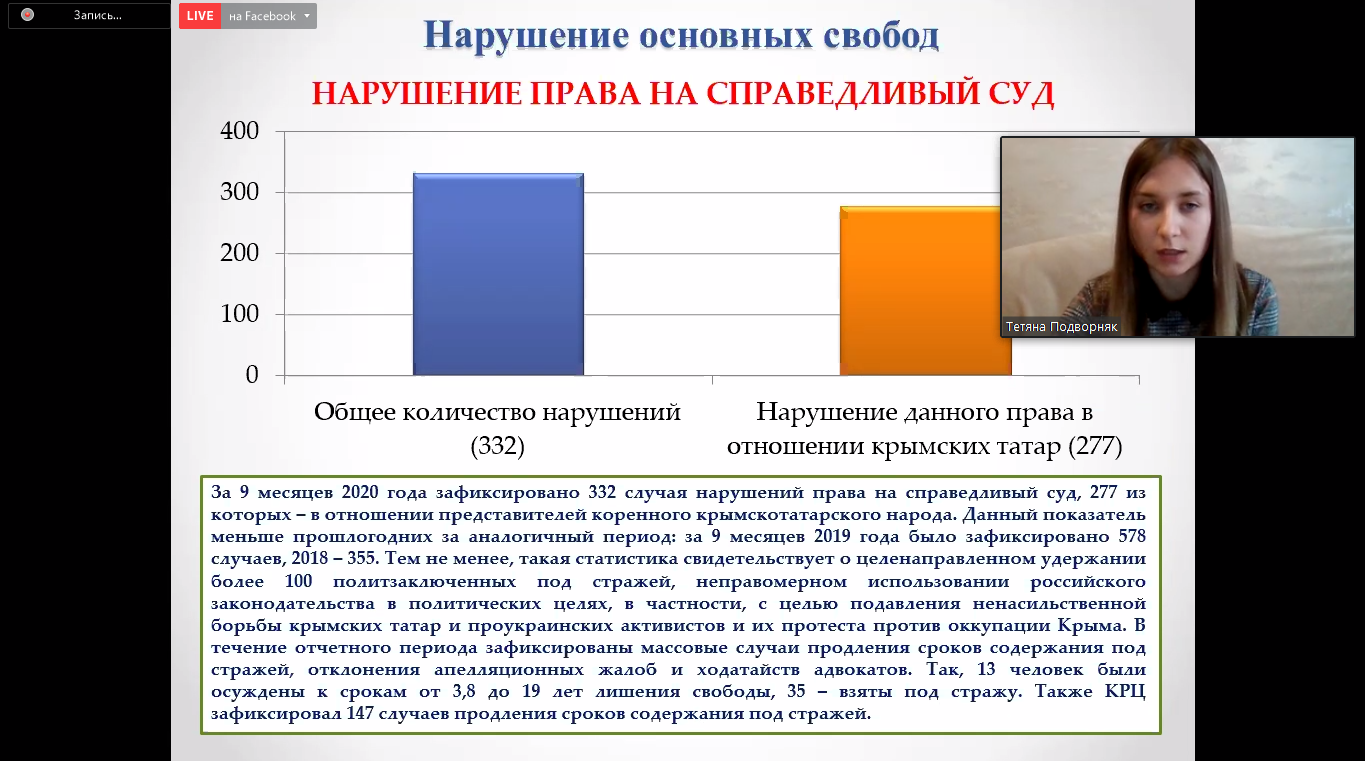
According to Tetiana Podvorniak, for 9 months of 2020, 332 cases of violations of the right to a fair trial were recorded, 277 of which were against representatives of the indigenous Crimean Tatar people. This figure is less than last year for the same period: 578 cases were recorded in 9 months of 2019, 355 in 2018.
“Nevertheless, such statistics indicate the deliberate holding of more than 100 political prisoners in custody, the illegal use of Russian legislation for political purposes, in particular, with the aim of suppressing the non-violent struggle of Crimean Tatars and pro-Ukrainian activists and their protest against the occupation of Crimea. During the reporting period, there were recorded massive cases of prolongation of detention periods, rejection of appeals and petitions of lawyers”,- Podvorniak said.
For 9 months of 2020, 112 cases of violation of the right to the highest attainable standard of physical and mental health were recorded, 91 of which were against Crimean Tatars. As Tetiana Podvorniak noted, this figure exceeds last year's for the same period: in 2019, 90 cases of violation were recorded, in 2018 – 40.
“During the reporting period, cases of non-provision of adequate medical care in places of detention were recorded on an ongoing basis, especially in the context of the coronavirus pandemic. It is known that not all political prisoners were provided with personal protective equipment. Such actions, in turn, led to a deterioration in health. At the same time, the petitions of lawyers were often ignored”,- said the communications manager of the CTRC.
According to her, in addition, there have been cases of forced placement of detained Crimeans in a psychiatric hospital, which is also a violation of the right to the highest attainable standard of physical and mental health.
In addition, as noted by Tetiana Podvorniak, for 9 months of 2020, 33 cases of transferring of political prisoners of Crimea were recorded, 27 of which were against representatives of the indigenous people. Last year, 69 cases of transferring were reported over the same period.
The CTRC report also contains information on systemic cases of vandalism, violation of religious rights, destruction of the ecosystem on the peninsula, inadequate conditions of detention in jails and prisons, violation of the rights of political prisoners and illegal military exercises in the occupied Crimea.
.png)
Refat Chubarov stressed the importance of systematic monitoring of human rights violations in the occupied Crimea. According to him, such information is basic for international organizations that are dealing with the topic of Crimea, in particular, when preparing resolutions.