

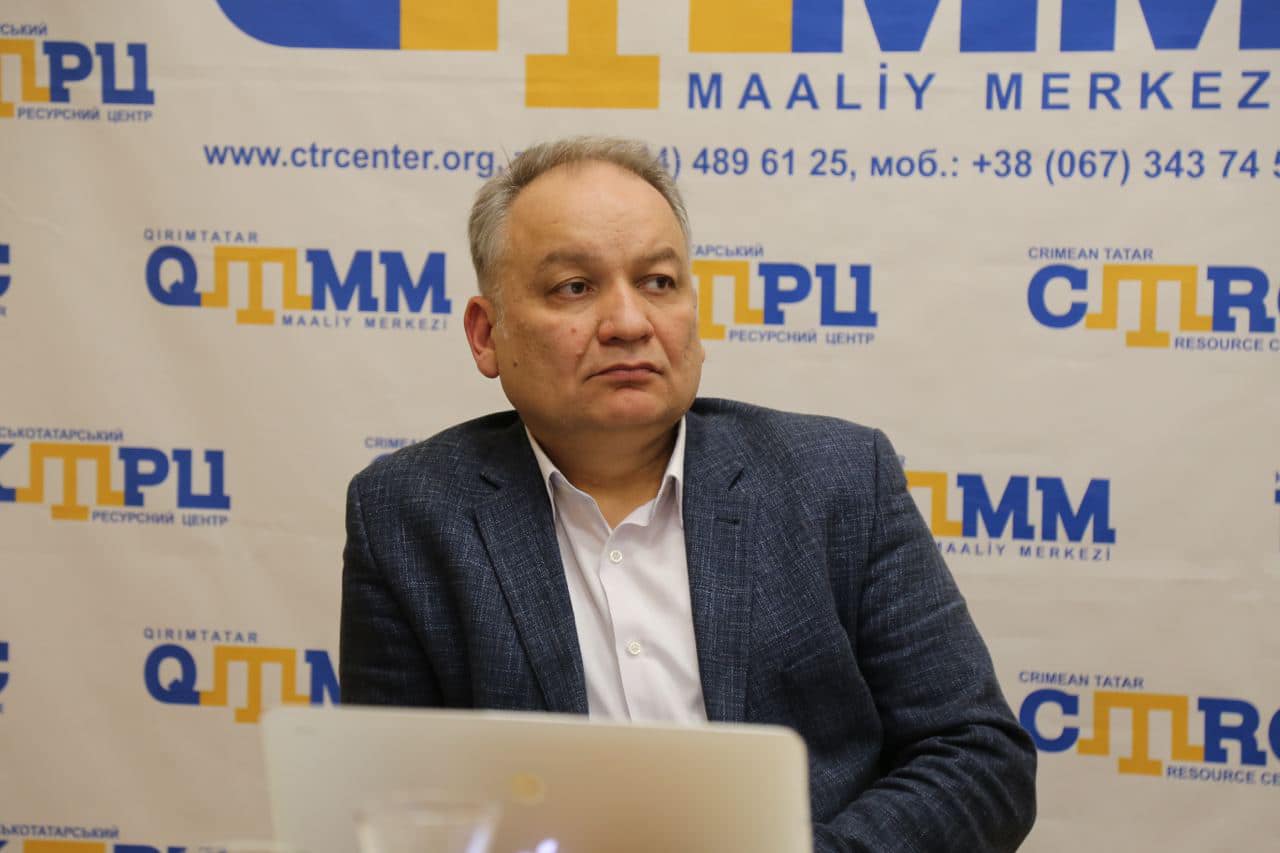
“In the 13th year of the Russian-Ukrainian war, the State Duma of the Russian Federation is passing a law allowing the seizure of the property of Russian citizens abroad if they commit administrative offenses that the Russian authorities interpret as ‘actions against the interests of the state.’
Finally, what the terrorist state has been doing for years—both against its own dissident citizens and against Ukrainian citizens in the occupied territories—will now be officially “legalized.” “It is no secret that Russians have been looting under the guise of nationalizing the property of Ukrainian citizens in Crimea practically from the very first days of the occupation,” – noted Eskender Bariiev.
According to him, all of this is due to serious problems in the Russian economy as well as criticism of the Russian president’s policies related to Russia’s unjustified aggression and criticism of the failed so-called ATO.
The human rights activist added that, according to the adopted law, bank accounts, funds, and other property of “Russian citizens” who, while outside the country, publicly oppose the Kremlin’s policies or engage in other actions that fall under certain administrative provisions of Russian law. Naturally, all of this will also apply to Crimeans in occupied Crimea who were forced to leave the peninsula, which the Russians de facto control and consider part of Russian territory.
“It is now 2026, and the property of the representative body of the Crimean Tatar people, banned by the occupiers in 2016, was seized and nationalized almost immediately after a search was conducted there in September 2014. Without any legal basis, the Mejlis building, located at 2 Schmidt Street in Akmesdzhit (Simferopol), was transferred to the city administration, which decided to open a children’s music school named after Alemdar Karamanov there for 140 children. “A very cunning and despicable move, because after deoccupation they will claim they are taking the building away from the children…,” emphasized the chairman of the CTRC board.
He noted that all those involved in the illegal appropriation of property in the occupied territories will be held accountable for their actions, and all illegally expropriated property will be returned to its rightful owners.
In conclusion, Eskender Bariiev emphasized that, in accordance with international law, the aggressor state will be obligated to fully compensate for the damage caused. Everything stolen will have to be returned, and Russian citizens will pay reparations for decades for the crimes of their regime.
May 29, 2026
Unfortunately, Anatoly Kobzar has still not received proper medical care, despite his critical condition. On January 8, he suffered a displaced arm fracture, but the cast was not removed until March 10. Due to delayed and inadequate treatment, the bone healed improperly, and his arm has effectively lost full functionality.
Additionally, on April 29, 2026, it became known that the political prisoner had suffered a ruptured eardrum. According to available information, the injury may have been the result of physical abuse during his detention.
Furthermore, the political prisoner complains of severe pain in his knees. According to the CTRC, he currently has difficulty moving around on his own and climbing stairs—he can only walk with assistance.
It has also come to light that he has serious dental problems. Some of his teeth were knocked out during interrogations and the use of physical violence following his detention. The remaining teeth require urgent medical attention due to a lack of proper treatment.
It is important to note that prior to his unlawful detention, Anatoliy Kobzar had no chronic illnesses or serious health problems. He has lost a significant amount of weight during his detention
It is important to note that prior to his unlawful detention, Anatoliy Kobzar had no chronic illnesses or serious health problems. During his detention, he lost a significant amount of weight—40 kilograms at a height of 193 cm. After his whereabouts became known and it became possible to send him care packages, he managed to regain some weight, but his health remains critical.
In addition, for seven months now, the detention center administration has refused to grant Anatoly Kobzar permission to meet with his relatives, which is why his family has been unable to see the political prisoner for a long time.
As a reminder, Anatoly Kobzar was illegally detained on March 5, 2024, in occupied Crimea. For a long time, Russian security forces concealed information about his whereabouts. Only after dozens of publications, appeals, and a systematic advocacy campaign did the FSB’s Central Regional Directorate (CRD) have to confirm the fact of his detention and his confinement in special units and pretrial detention centers in occupied Crimea.
He is currently being held in Pretrial Detention Center No. 2 in Akmesdzhit (Simferopol) on fabricated charges of “treason.” He faces up to 20 years in prison.
The Crimean Tatar Resource Center emphasizes that the failure to provide adequate medical care, the concealment of the place of detention, physical violence, and torture against civilians constitute gross violations of international humanitarian law and may be regarded as inhumane treatment.