

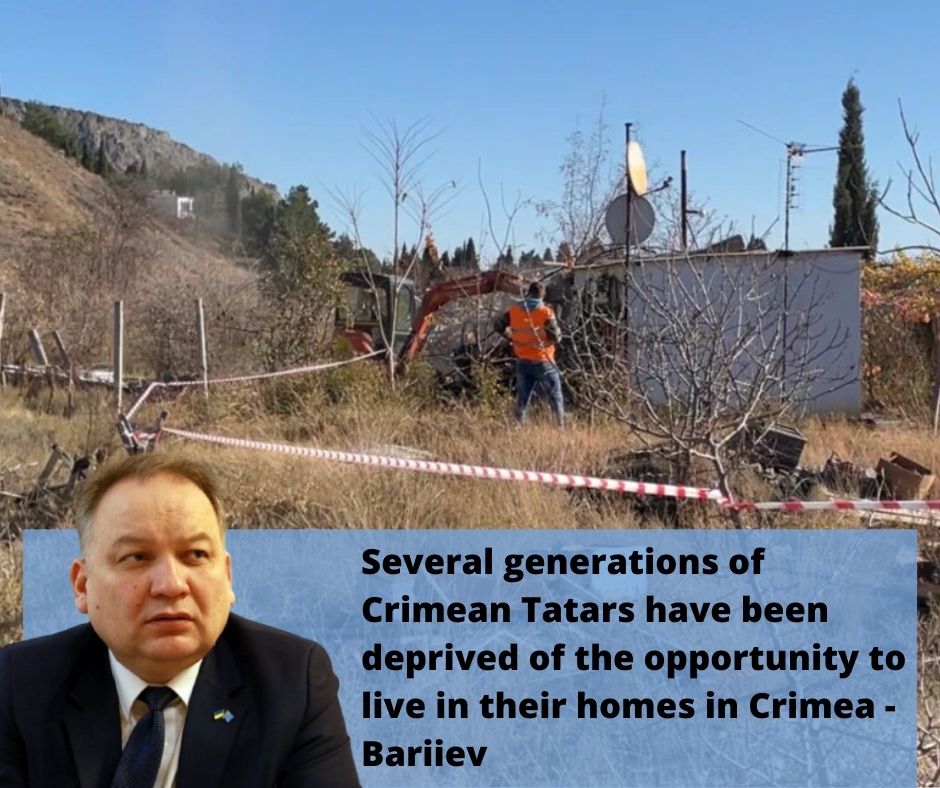
Head of the Board of the Crimean Tatar Resource Center, Head of the Department of Legal and Foreign Affairs of the Mejlis of the Crimean Tatar People Eskender Bariiev, commenting on the demolition of the house of a veteran of the Crimean Tatar national movement Rustem Useinov, said that several generations of Crimean Tatars have been deprived of the opportunity to live in their homes in their homeland in Crimea.
“After the annexation of Crimea in 1783, many years of mass emigration began, the pace of which varied depending on the policy of Russia. Emigration reached its peak during the Crimean War of 1853-1856, when the repressions against the Crimean Tatars sharply intensified. In the fall of 1854, they began to be resettled from the coastal areas. As a result, 141,567 Crimean Tatars left Crimea. Catherine's annexation of Crimea turned into a disaster for the Crimean Tatars. Crimean Tatars call this epoch the Black Century”,- he said.
The next stage of the mass migration of the Crimean Tatar people was the total deportation on May 18, 1944. By the decision of the State Defense Committee of the USSR, the entire people were uprooted from their historical homeland and forcibly resettled to the Urals, Siberia and Central Asia. 46.2 percent of the deported Crimean Tatars died from hunger, disease and other reasons during the first year and a half of deportation.
“For more than 50 years, Crimean Tatars have fought for the right to live in their homeland. There was no talk about returning our houses or stolen property in Crimea to us. Those who tried to return in the late 70s and early 80s were subjected to secondary deportation to the Kherson Region and Krasnodar Region. So during one of these cases, the child of an activist of the national movement of the Crimean Tatars, Vedzhiie Kashka, died. Police officers doused the baby with a bucket of cold water, loaded it into a truck and threw it out at the border in the Kherson Region. As a result of hypothermia, the child died. And Vedzhiie khanum herself died at the hands of the occupants on November 23, 2017”,- he explained.
According to Bariiev, at the time of the return of representatives of the Crimean Tatar people to Crimea in the 90s, complete strangers lived in their houses, and some houses and villages were completely wiped off the face of the earth.
“The Crimean Tatars were unwanted guests on their land. Anyone who wanted to settle in Simferopol or on the southern coast of Crimea, at best, was advised to go to the steppe regions of Crimea. Nevertheless, at the end of the 90s, with great difficulties and trials, most of the people were able to return to Crimea, build their temporary huts from scratch, and then houses on the plots that we had to self-return. For many years, the authorities refused to legalize both land plots and houses built on them, finding thousands and thousands of reasons not to do this”,- added the Head of the Board of the CTRC.
And on November 24, 2021, history repeated itself. The house of the Crimean Tatar activist Rustem Useinov was destroyed in the village of Morske in Sudak by 20 riot police officers and builders with heavy equipment, despite the approach of winter.
Unfortunately, thousands of Crimean Tatars may find themselves in his place, as they live in unregistered houses and plots. The occupiers, who illegally seized Crimea in 2014, in turn, use it perfectly as one of the tools to squeeze representatives of the indigenous people from their land.
“Since 2014, I have repeatedly stated that the Ukrainian authorities need to legalize all self-returns and the houses located on them. Yes, the Ukrainian government does not control the territory of the Autonomous Republic of Crimea, but it can give its citizens the right and the opportunity to defend their land and property in international courts”,- Eskender Bariiev summed up.