

On August 16, 2021, the so-called final trial in the so-called Hizb ut-Tahrir case was held at the Southern District Military Court of Rostov-on-Don. Lenur Khalilov, Ruslan Mesutov, Ruslan Nagaev, Eldar Kantimirov were sentenced.
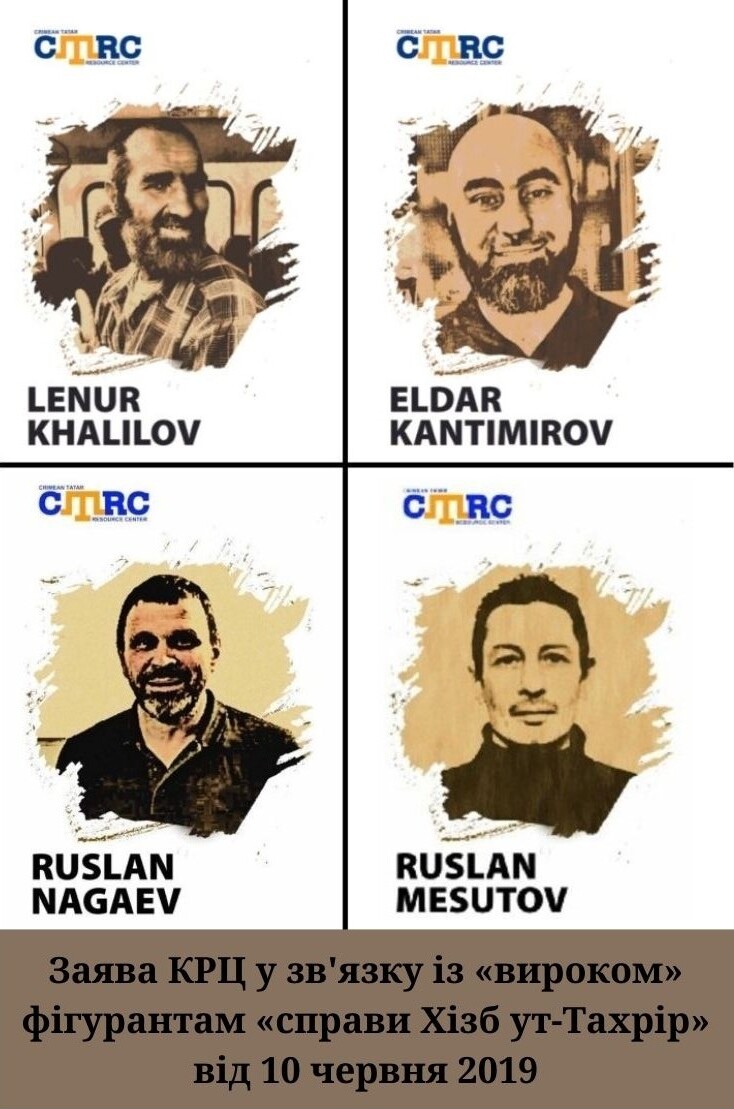
Lenur Khalilov was found guilty of committing a crime under Part 1 of Article 205.5, Part 1 of Article 30 and Article 278 of the Criminal Code of the Russian Federation and sentenced to 18 years in prison with a probation for 1 year and 6 months.
Ruslan Mesutov was found guilty of committing a crime under Part 1 of Article 205.5, Part 1 of Article 30 and Article 278 of the Criminal Code of the Russian Federation and sentenced to 18 years in prison with a probation for 1 year and 6 months.
Ruslan Nagaev was found guilty of committing a crime under Part 2 of Article 205.5, Part 1 of Article 30 and Article 278 of the Criminal Code of the Russian Federation and sentenced to 13 years in prison with a probation for 1 year.
Eldar Kantimirov was found guilty of committing a crime under Part 2 of Article 205.5, Part 1 of Article 30 and Article 278 of the Criminal Code of the Russian Federation and sentenced to 12 years in prison with a probation for 1 year.
All four men, residents of Alushta, were detained on June 10, 2019, after searches were carried out in their households.
Lenur Khalilov (born in 1967) – head and founder of the Muslim community "Alushta";
Ruslan Mesutov (born in 1965) – security guard in the Muslim community "Alushta";
Ruslan Nagaev (born in 1964) – entrepreneur;
Eldar Kantimirov (born 1980) – Arabist, entrepreneur, activist.
The accusations in this so-called case are based on the testimony of the so-called hidden witnesses and the conclusions of experts who actively cooperate with the FSB. The only evidence was banned Islamic literature found during searches, FSB operational data and audio recordings in which it was recorded that the convicts were engaged in discussions on religious and political topics. The activists are accused of involvement in activities of the banned in the Russian Federation organization Hizb ut-Tahrir, which has no restrictions on its activities in most countries of the world.
The so-called case was considered in gross violation of international law. The so-called defendants were systematically restricted in the right to liberty and security of person, the right to a fair trial, the right to an effective legal defense, the right to respect for private and family life, freedom of thought, conscience and religion, freedom of expression, were subjected to inhumane and degrading of treatment. Also, within the framework of this so-called case, the right to punishment was violated solely on the basis of the law, since the Russian Federation, as an occupying state in accordance with the IV Geneva Convention, has no right to extend its criminal legislation in the occupied territory of Crimea.
The Crimean Tatar Resource Center strongly protests and states that this decision is illegal, politically motivated and criminal.
This policy of the Russian Federation is a demonstration of the fight against dissent, as well as the religious and political beliefs of the people in the occupied Crimea.
In addition, the decision of the Southern District Military Court in Rostov-on-Don testifies to the ongoing repression and pressure on the indigenous Crimean Tatar people.
The Russian Federation improperly uses its legislation for political purposes, in particular, with the aim of suppressing the non-violent struggle of the Crimean Tatars and their protest against the occupation of Crimea.
The Crimean Tatar Resource Center demands the cancellation of the verdict of the defendants in the so-called June 10, 2019 Hizb ut-Tahrir case and the immediate release of other political prisoners.
The Crimean Tatar Resource Center calls on the international community to increase pressure on the Russian Federation in order to end political persecution in Crimea, as well as to impose personal sanctions against those responsible for human rights violations in Crimea.
Press Service of the Crimean Tatar Resource Center