

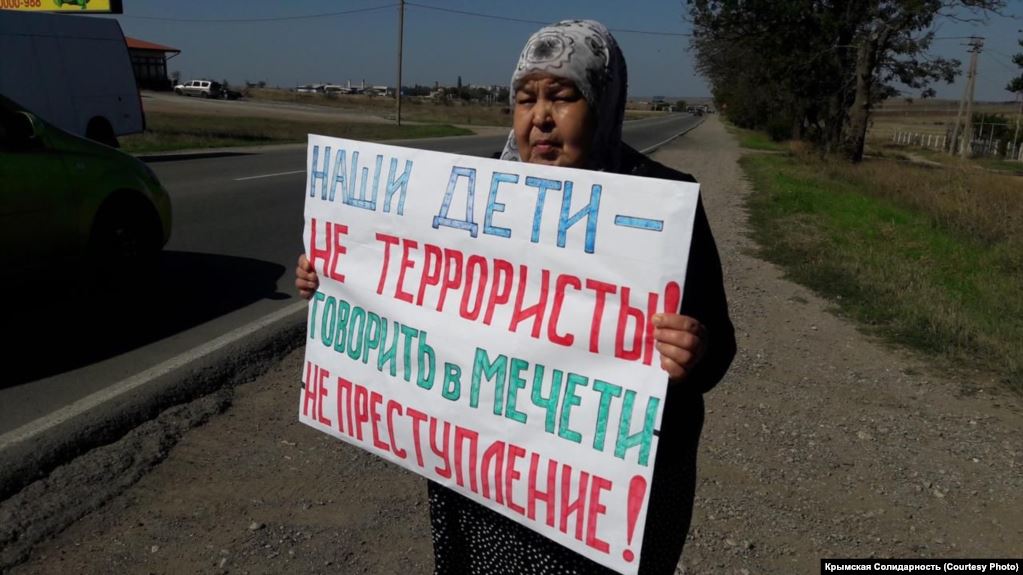
Relatives of the defendants in the so-called second Bakhchisaray Hizb ut-Tahrir, who will soon be sentenced for tens of years, go to single pickets. They demand the release of political prisoners, since “talking in a mosque is not a crime.”
Server Mustafayev's mother Venera was holding a poster with the inscription: “Talking in a mosque is not a crime! Give me back my son!”, And Edem Smailov's mother-in-law – “Our children are not terrorists! Talking in a mosque is not a crime!”
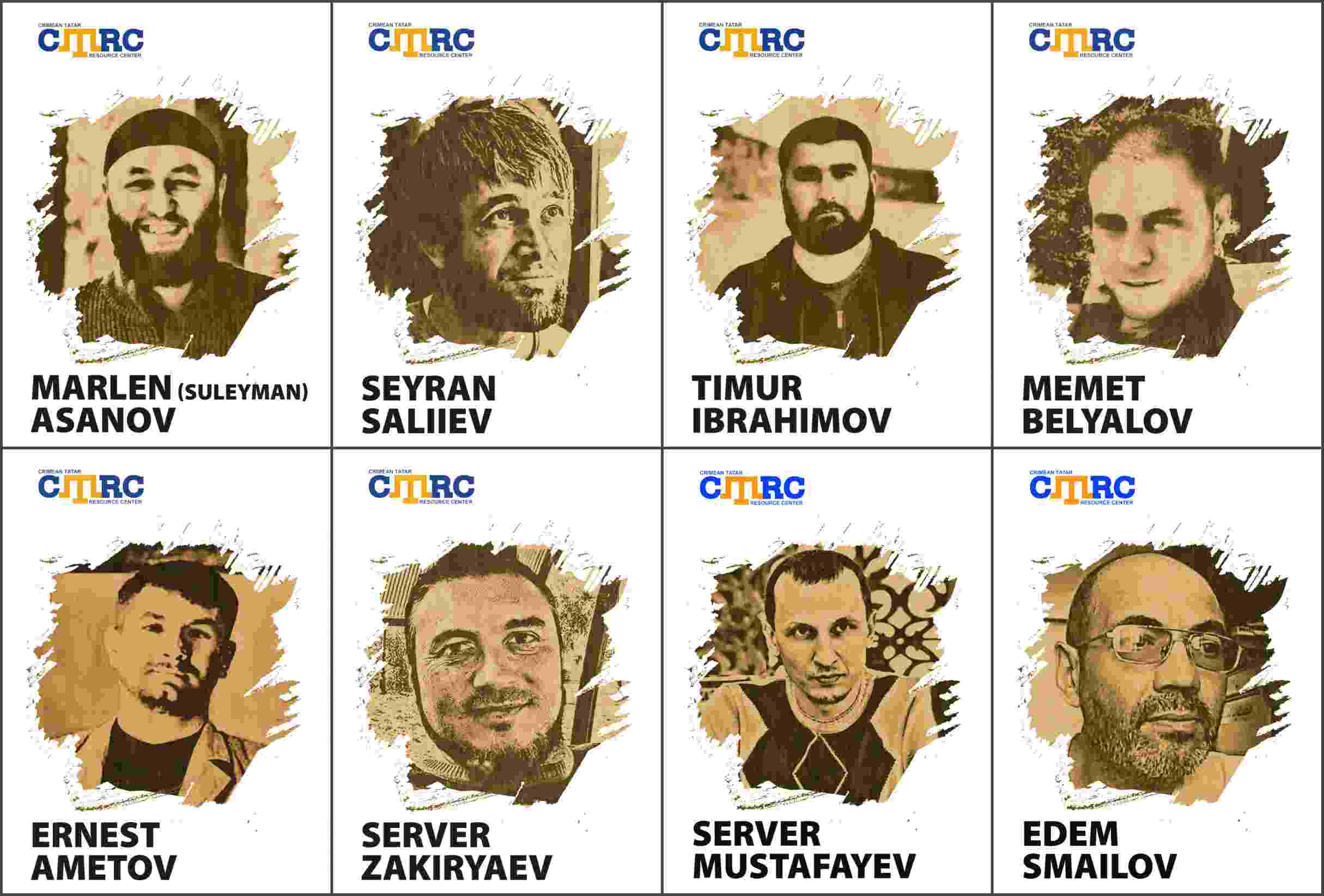
We remind that on October 11, 2017, in the city of Bakhchisaray, the invaders carried out mass searches in 6 dwellings of Crimean Tatars – Marlen Asanov, Seiran Saliiev, Timur Ibrahimov, Memet Belyalov, Ernest Ametov, Server Zakiryaev. Everyone was detained. They were charged under Article 205.5 of the Criminal Code of the Russian Federation “Participation in the activities of an organization which, in accordance with the legislation of the Russian Federation, is recognized as terrorist”.
On May 21, 2018, Russian security forces raided the dwellings of activists of the Crimean Solidarity public association in the occupied Crimea, as a result of which Server Mustafayev and Edem Smailov were detained. They were also accused of their membership in Hizb ut-Tahrir organisation, which is prohibited on the territory of the Russian Federation.
In February 2019, a criminal case was opened against eight individuals involved in the so-called second Bakhchisaray Hizb ut-Tahrir case – Marlen Asanov, Seiran Saliiev, Timur Ibrahimov, Memet Belyalov, Ernest Ametov, Server Zakiryaev, Server Mustafayev and Edem Smailov (“Violent seizure of power or violent retention of power”).
On March 5, it became known that the two defendants in the so-called second Bakhchysarai Hizb ut-Tahrir case – Timur Ibrahimov and Memet Belyalov – had their charge tightened from part two of Article 205.5 of the Criminal Code (“participation in the activities of a terrorist organization”) to the part one (“organization of the activities of a terrorist organization”).